My THELoginRegister
Third Level Navigation:
09 September 2010

Advertisement

Advertisement

Advertisement

-
Main Page Content:

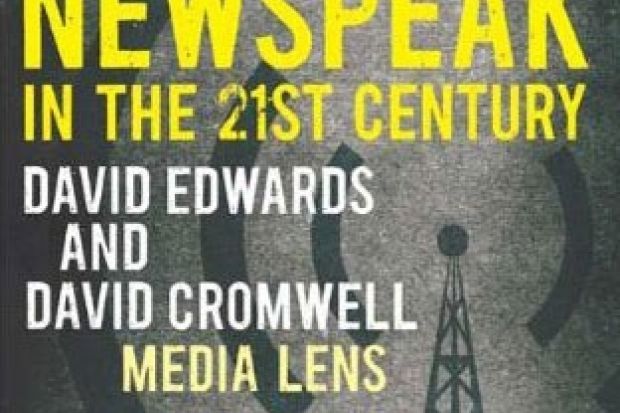
Newspeak in the 21st Century

12 November 2009

Newspeak in the 21st Century is the latest publication from Media Lens, a campaign group that undertakes press monitoring from an anti-war, anti-corporate perspective. Tackling left-liberal UK publications including The Independent and The Guardian, and public service news providers, it contends that the "best" British news providers are not to be trusted.

Initially, this makes for a compelling intervention in media politics. Time and again, the authors point out how Western corporate and geopolitical interests are upheld consistently within respectable news reporting. The authors' targets include historical amnesia, uncritical treatment of Establishment sources and dubious choices of wording.

Newspeak's marketing material describes the acclaim and success of the group's previous book, Guardians of Power: The Myth of the Liberal Media (2005); at the time of writing, the Media Lens website links to at least two dozen reviews of the earlier book. This is hard to tell from Newspeak's opening section, which contends that Guardians of Power was ignored by the mainstream media. Paradoxically, the discrepancy between the book's marketing blurb and its protracted complaining is exactly the kind of inconsistency for which the left-liberal press gets taken to task.

This same spirit of wanting to have its cake and eat it too pervades the book's pantheon of heroes and villains. Noam Chomsky is saintly, despite not being a Buddhist; John Pilger is brave; George Monbiot is OK on climate change but not on war or advertising; Robert Fisk merely maintains public illusions in the corporate media.

Various senior editors are portrayed as beyond the pale, especially once they fire off an expletive-laden email to Media Lens, presumably out of frustration with the incoming spam from their online antagonists. Throughout, there is grumbling about the victimisation of Media Lens contributors, illustrated by reprinted email correspondence from people who happen to disagree with them.

The book improves, however, whenever David Edwards and David Cromwell drop the autobiographical self-pity. They often perform a solid, readable diagnosis of how the media get particular stories wrong owing to systematic bias.

They detail, sometimes verbatim, how news anchors ask studio guests and war correspondents if a particular military engagement should continue in order to fulfil its declared aims, or whether this would only make matters worse. They are reasonable-sounding questions until one realises that few would ever ask if a specific intervention is an illegitimate attack on the sovereignty of another state. According to Media Lens, this televised succession of false choices curtails critical journalism and limits the audience's political horizons.

The authors map the selective memories of certain newspapers, which treat some casualties as more important than others. They look at how the BBC describes Venezuela's Hugo Chavez in terms never used when reporting on Barack Obama or Gordon Brown, despite the broadcaster's formal commitment to "due impartiality".

Echoing Chomsky, they suggest a cumulative pattern of conservative, pro-corporate influence derailing progressive social change. Despite its often-convincing case studies, once Newspeak tries to account for the relationship between journalism, the media industries and society, it deteriorates into mere assertion.

Noting that The Guardian and The Independent rely heavily on advertising is not the same as demonstrating that advertisers are able to determine content, especially on a topic as specific as coverage of Iranian support for Iraqi insurgents.

Suspicion alone is not enough to confirm that the "best" media - broadsheets and public service broadcasters - are "cheerleaders for government, business and war" and simply "watching" the media does not give a particularly accurate account of how they work.

For instance, although the formal distinction between fact and opinion is often blurred in the ways Edwards and Cromwell demonstrate, one cannot prove that newspaper reporting is biased simply because a disagreeable opinion piece appears elsewhere in the same publication. Extracts from the memoirs of US news anchors reveal something about network office politics, but are not sufficient to indict public service broadcasting in Britain. Flitting around between frontline reporters, newsreaders, editors, tabloids, broadsheets, advertisers and spin doctors won't establish proof of systematic brainwashing if it merely asserts the malign influence of hidden agendas.

If Newspeak's move from case studies to media system analysis is unsatisfactory, its treatment of audiences - apparently under the spell of thought control - lacks any supporting evidence. Audience and circulation sizes are in decline, but the majority of us are presented here as unquestioning consumers apart from the small minority who, so appalled by US/UK foreign policy, are automatically compelled to bomb their fellow citizens.

Choice, consciousness and ethics simply don't come into it; but if that is indeed the case, why would anyone bother getting involved in an organisation such as Media Lens?

Newspeak in the 21st Century

-

By David Edwards and David Cromwell
Pluto Press
304pp
£55.00 and £16.99
ISBN 9780745328942 and 28935
Published 28 September 2009

Reviewer :

Graham Barnfield is programme leader in journalism, University of East London, and a former account director for a public relations firm.

Readers' comments

  • David Edwards 12 November, 2009

    Barnfield writes:

    "Newspeak's marketing material describes the acclaim and success of the group's previous book, Guardians of Power: The Myth of the Liberal Media (2005); at the time of writing, the Media Lens website links to at least two dozen reviews of the earlier book. This is hard to tell from Newspeak's opening section, which contends that Guardians of Power was ignored by the mainstream media. Paradoxically, the discrepancy between the book's marketing blurb and its protracted complaining is exactly the kind of inconsistency for which the left-liberal press gets taken to task."

    The book got one positive review in the New Statesman, a sneery review in the Spectator. To this day, Guardians of Power has never been so much as mentioned, much less reviewed, in any UK national newspaper.

  • David Sketchley 12 November, 2009

    Interesting that the Times Higher Education has published a review of Newspeak by a corporate propagandist. Says it all really.

  • Oliver Kamm 12 November, 2009

    One point relevant to assessing the credibility of Media Lens's approach is that they maintain that reports of the Srebrenica massacre - an act of genocide, as determined by the International Court of Justice - are an example of Western corporate propaganda. Edwards and Cromwell, who have no background in Balkan politics, promote the Srebrenica-denial of their intellectual mentor Ed Herman. For sources, see my recent article "The funny side of genocide" at TimesOnline.
    http://timesonline.typepad.com/oliver_kamm/2009/10/the-funny-side-of-genocide.html

    It's a bleakly comic aspect of the book under review that its authors take exception to the description of Media Lens as a reliable conduit for genocide-denial even though this is demonstrably true.

  • Media Lens 12 November, 2009

    Kamm is inventing. We have never argued that "reports of the Srebrenica massacre... are an example of Western corporate propaganda". We have hardly written about the issue at all, other than to affirm that there was indeed a massacre at Srebrenica, and to defend Noam Chomsky against the Guardian's claim in 2005 that he had denied the massacre took place (he had not).

    Kamm, who has no background in Iraqi politics, wrote of the 2003 invasion:

    “Contrary to the Liberal Democrats’ depiction of it as the biggest foreign policy error since Suez, Iraq was the most far-sighted and noble act of British foreign policy since the founding of Nato. Mr Blair’s record exemplifies foreign policy ‘with an ethical dimension‘.” (Oliver Kamm, 'Help, I'm a pro-war leftie,' The Times, May 2, 2005; (http://www.timesonline.co.uk/tol/comment/thunderer/article387488.ece)

  • Oliver Kamm 12 November, 2009

    I'm more than willing to debate my support for the interventionist foreign policies of Tony Blair, but that isn't the subject of this THES review. I'm unsurprised at their defensiveness, but Cromwell and Edwards are manfacturing their own history here, and a very recent history at that. Genocide-denial is not some incidental aspect of the work of their guru Ed Herman and his associate David Peterson: it is they very hypothesis that Cromwell and Edwards promote on their site (see my article for details). Cromwell and Edwards's claim that they "affirm that there was indeed a massacre at Srebrenica" is mere dissembling.

    The issue at stake in the non-debate over Srebrenica is NOT whether a group of Bosniaks were massacred (or, as Herman and Peterson disgracefully put it, "executed" - as if there had been some judicial process behind it). It concerns the documented fact and legal judgement that 8,000 Bosniak men and boys were slaughtered in an act of genocide by Bosnian Serb forces. Herman and Peterson, through their absurdly-named Srebrenica Research Group, deny this. They maintain that "the available evidence indicates hundreds of executions, not 8,000 or anything close to it".

    This is the propaganda - I won't call it work, still less research - that Cromwell and Edwards promote on the Media Lens site - see my article for details. In short, the Herman-Peterson claim is not just the denial of the ICJ judgement that the Srebrenica massacre was genocide: it is the denial that the massacre of 8,000 unarmed Bosniak civilians even took place.

    David Aaronovitch, Francis Wheen and I have dissected the techniques of such writers, and explained how closely they resemble - indeed replicate - the methods of Holocaust denial. Media Lens's promotion of such material is a relevant point in assessing the credibility of their claims about corporate propaganda, which is why I draw it to the attention of THES readers.

  • Themos Tsikas 12 November, 2009

    They maintain that "the available evidence indicates hundreds of executions, not 8,000 or anything close to it", writes Kamm.

    That still does not contradict either the existence of a massacre or a genocide act with 8000 victims. There are other ways of killing people, not just executions of bound captives. In 1991, on the Basra road, "thousands died in their vehicles" after "allied forces bombed them from the air", reported the BBC.

  • Miriam Cotton 12 November, 2009

    Letter sent to Graham Barnfield today.

    Dear Graham Barnfield

    I write to point out an obvious misunderstanding in your review of [Newspeak] book.

    Media Lens is not a 'campaign group' in any shape or form. It stands in exactly the same relationship to its readers as the Times does to it's own. The only difference is that it is on the internet and so, as readers, we have the facility of being able to post our own thoughts and responses to the material which the editors of the site may publish there - without being filtered through a letters page editor. As with Times readers, there is certainly a majority who are broadly sympathetic to the Media Lens' editorial perspective. As with those who write to the Times letters page we cannot be considered a 'campaign group' by virtue of sharing and expressing a similar opinion. I have only ever met one person who posts to Media Lens - the vast majority of us have never met or corresponded in any way other than through the Media Lens website itself. We have never been collectively associated in our correspondence with journalists as a consequence of what we read on Media Lens and, as with this letter, have never sought approval or editorial input from Media Lens in that correspondence. Media Lens have no more knowledge of this letter than does the editor of The Times at the time of writing. Are posters to The Times online also to be regarded as a 'campaign group' if they happen largely to agree about what they have read there? They are contributing in identical circumstances.

    May I suggest that your are manifesting symptoms of the general difficulty so many journalists and others connected to the mainstream media are having with internet media activity? You are confusing the nature of the electronic medium with the substance of what is being said and, sadly, largely missing the point of the latter in so doing. Edwards and Cromwell are making what are at bottom really very straightforward observations about the media and which are of a kind that might be observed about any common human activity: that the conventions of mainstream liberal news media are tending substantially to favour a certain sort of person with a certain sort of outlook; that journalists are operating to givens and norms established by themselves, for themselves in the conduct of their work and which are going almost completely unquestioned. Media Lens happen to be the first to have made these observations out loud from outside the British media establishment. That they are on to something incredibly important is evident in the disappointing and typically peevish/resentful/angry/vain reactions they get from so many. They remain incredibly polite in the face of all of this and stubbornly focused on the issues they feel are suffering because of media failure to report them in a genuinely balanced and comprehensive way. You acknowledge that their examples and case studies prove the point but take issue with their analysis of why the things they observe are happening.

    Do you have better explanations for them?

    Sincerely
    Miriam Cotton

  • Media Lens 12 November, 2009

    According to our archive, since 2001, we have published 2,758 pages of media alerts totalling some 1016310 words of material. As discussed, we have written virtually nothing about the massacre at Srebrenica. Is there really nothing that Kamm can find in these 2,758 pages to take issue with? It is really desperate to focus on two writers who are not part of Media Lens and who have written about an issue we ourselves have barely discussed at all.

    By contrast, we have no problem finding examples of Kamm's work that are worthy of challenge. We estimate that, last year, Kamm was one of only two people on the planet who believed this of George Bush:

    "For all his verbal infelicity, diplomatic brusqueness, negligence in planning for post-Saddam Iraq, and insouciance regarding standards of due process when prosecuting the war on terror, the world is a safer place for the influence he has exercised."
    (http://www.guardian.co.uk/commentisfree/2008/jun/17/georgebush.terrorism)

  • E Cook 12 November, 2009

    The comments have made me chuckle.

    Kamm's feeding-frenzy on Media Len's alleged views about Srebrenica is as predictable as it is tiresome. As has quite rightly been pointed out, Kamm's argument concerns two writers who are not even part of Media Lens. Nevertheless, he believes he's found his stick to beat them with, and - red-faced and panting - beat them he will.

    Elsewhere, he has resorted to childishly insulting Media Lens as "unlettered". All told, Kamm seems to take an unusually aggressive interest in their work.

    Coming from such a widely abhorred figure, such unvarnished bitterness really can only be a compliment - and might also indicate that Media Lens are onto something.

    I'm a regular reader of Media Len's work (and that of their detractors, too), but I have never emailed a journalist as a result of their exhortations. Like Miriam Cotton above, I simply value their commentary and wish there was more of it in the mainstream media - which, as is evident to anyone with half a brain, is guilty of shockingly poor performance on almost every issue of critical importance.

    Heightening scepticism, engaging in dialogue with agenda-setting voices, challenging top-down narratives and encouraging individuals to pluralise their media intake, analyse traditional sources of information and support alternative channels – these are fundamentally worthwhile tasks, I think we’d all agree (Kamm aside). They are democratic aims, pure and simple.

    This is not a game of point-scoring with already-busy journalists. It is far more important than that. The gravity of the times, quite simply, demands that we examine the voices who monopolise mass communication in this society.

  • Oliver Kamm 12 November, 2009

    As I have said, I'm more than willing to debate the interventionist policies of Tony Blair, which I support, and their adoption by President Bush after 9/11. But my views on foreign policy are not the subject of the THES review. The review is about the work of Media Lens, which THES readers may not be familiar with.

    Cromwell and Edwards are well aware that I have spent more time dissecting their critiques than any other journalist for the mainstream press. I examined at far greater length than they merited the alerts put out by the organisation concerning media treatment of the history of the Hiroshima and Nagasaki bombings. I concluded beyond reasonable dispute that Cromwell and Edwards were ignorant of the historiographical debates on the subject (they couldn't even get right the name of their own cited source, Gar Alperovitz, the main populariser of the long-debunked "atomic diplomacy" thesis).

    But Media Lens's mere haplessness is also secondary to the issue that I've raised. Of course Media Lens have written next to nothing about the genocide at Srebrenica. The men and boys consigned to mass graves at Srebrenica don't figure in Media Lens's world view. For Media Lens, they're unimportant. As I argued in the article I've linked to, Media Lens promotes the grotesque writings of Herman on the subject because Cromwell and Edwards are essentially clueless on Balkan issues. But cluelessness is no excuse for the denial of genocide and the whitewashing of the single greatest war crime to have been committed on European soil since the defeat of Nazism. That's what Media Lens's intellectual mentors and friends do, so Media Lens promotes their work as "the definitive critique" of supposed Western corporate propaganda. This is, as I have said, highly relevant to assessing the robustness of Media Lens's critique. In my view, the moment you start treating this cause, you're outside serious, let alone civilised, debate.

  • Themos Tsikas 12 November, 2009

    "That's [denial of genocide and the whitewashing of the single greatest war crime to have been committed on European soil since the defeat of Nazism] what Media Lens's intellectual mentors and friends do"

    I assume the quote Kamm posted is the most damning he could find. It does not support his thesis.

    But more to the point, it's a ridiculous stick to beat ML with, akin to accusing the BBC of wholesale denial of climate change on the basis of one broadcast interview with one scientist.

  • Oliver Kamm 12 November, 2009

    Re: my comment: 'But cluelessness is no excuse for the denial of genocide and the whitewashing of the single greatest war crime to have been committed on European soil since the defeat of Nazism. That's what Media Lens's intellectual mentors and friends do, so Media Lens promotes their work as "the definitive critique" of supposed Western corporate propaganda.'

    I realise that, by an ambiguity, this may cause THES readers to underestimate the gravity of the charge. When I say that Media Lens promote the work of Herman-Peterson as "the definitive critique" of Western corporate propaganda, I mean the work of Herman-Peterson specifically ON SREBRENICA, and not just on other subjects. Cromwell and Edwards, in short, praise as definitive a work of genocide denial.

  • Media Lens 12 November, 2009

    Kamm writes of Herman and Peterson:

    "Media Lens promotes their work as 'the definitive critique' of supposed Western corporate propaganda."

    That sounds like Kamm is quoting us, does it not? But on his website, he notes that the "phrase comes from the abstract of the article by the editors of Monthly Review".

    So, to be clear, Kamm's criticism is focused on our highlighting the opinion expressed by the editors of Monthly Review on two writers who are not part of Media Lens and who have written about an issue we ourselves have barely discussed at all.

  • Daniel Simpson 12 November, 2009

    Come on David(s). You've posted their work on Yugoslavia uncritically for years, and I've been criticising you for it for years too, though you've not once to my knowledge acknowledged any fault with what they write. My last email to you on the subject stated the following: [QUOTE] I appreciate that you have respect for, and presumably trust, Ed Herman and David Peterson, who correspond with you often. But that doesn't make their work accurate: http://members5.boardhost.com/medialens/msg/1255618417.html

    Indeed, to mangle a presumably familiar Guardian quote, it may be extensively researched but it is inaccurate. I've not got time, nor the references at my fingertips to give you a line-by-line critique, but this one does a good job on the generalities: http://www.fpif.org/fpiftxt/5972

    Of course the media hyped humanitarian intervention, and thereby fuelled the fire for later "crusading". But exploitation and exacerbation don't mean that all the established facts somehow don't exist.

    To keep it really simple, sticking to the Srebrenica case, there are lots of bits of bodies in bags being DNA matched to the list of the missing. Eventually there'll be more corpses buried. If you want to argue 8,000 didn't die, as Herman and Peterson do (like Diana Johnstone), you have to show where they went, not just cite some 1995 press releases selectively, and misrepresent the Hague tribunal evidence.

    I don't know why you continue to circulate their work on Yugoslavia uncritically. Presumably it's because they stick the boot in to craven hacks, and you look up to them. I think in this case you're mistaken, and should stop posting the material unless you want to mislead readers intentionally.

    [CLOSE QUOTE]

    Cluelessness doesn't really come into it, unless it's intentional. Anyone labouring under the misapprehension that this renders me some kind of Henry Jacksonite need only read my blog to reassure themselves that my agreement with Oliver Kamm here implies no like-mindedness about warmongering elsewhere: http://danielsimpson.wordpress.com

  • Media Lens 12 November, 2009

    While Oliver Kamm ponders how to extricate himself from the mire of his latest post, readers might like to refer back to Richard Seymour's astute comments on Kamm's powers of analysis, both generally and on Hiroshima & Nagasaki: http://www.medialens.org/forum/viewtopic.php?t=2716 (see reply by 'lenin'). In summary, "Kamm's method appears to consist in haughty denunciation and smear."

    As Kamm is fond of waving around the accusation of "denier", one should bear in mind that he is a denier of aggression (e.g. the US-UK in Iraq, Israel in Lebanon); a denier of ethnic cleansing (when Israel does it); and a denier of genocide (e.g., the sanctions of mass destruction in Iraq).

    For those who don't know him, Kamm is a former financial speculator and is now a leader writer at the Times.

    On the former Yugoslavia, readers can make up their own minds about Herman and Peterson's arguments, and the sophistry deployed by their opponents, by studying this essay closely: http://www.monthlyreview.org/1007herman-peterson1.php


  • Themos Tsikas 12 November, 2009

    "If you want to argue 8,000 didn't die, as Herman and Peterson do", says Daniel Simpson. I disagree, they don't. What they do is examine the evidence and point out some problems in that evidence. All similar events are plagued by similar problems, I expect. The interesting question then, that Herman addresses, is what standard of proof is considered appropriate and how these problems are handled by propagandists when they wish to use the atrocities to justify some political action (eg, "we saved them from genocide") and how they are handled by (the same, frequently) propagandists when it is their side that is implicated in the atrocities (wg, "war is an ugly business but we brought peace and progress to the region").

  • Tim Holmes 12 November, 2009

    Why exactly should posting something without passing judgment on its conclusions and allowing readers to form their own opinions be construed as approval, let alone "promotion" of that material? If the Editors wanted to write approvingly of that content, they could easily have done so.

    More interesting is what this episode says about Kamm. He has quite consciously and deliberately taken a phrase used by the Monthly Review - he knows that's the source, because points out its provenance in his own blog post, which he cites above - and attributed it to Media Lens! In a comment on the same blog post, on this basis he claims that Media Lens "dance on a mass grave that they claim isn't there because Herman told them so" - as libellous a comment as it's possible to imagine. So where exactly have Media Lens' editors claimed it isn't there, Oliver? (Maybe you can dig a quote out of an old Ed Herman article ...)

    http://timesonline.typepad.com/oliver_kamm/2009/10/the-funny-side-of-genocide.html#comment-6a00d83451586c69e20120a648964a970c

  • Daniel Simpson 12 November, 2009

    Themos says: "What they do is examine the evidence". That's the problem, they don't. Johnstone told me in 2005 (at the time of You Know What) that she hadn't looked at it at all in years, yet was still writing columns based on her misrepresentations of old stuff. It's really pretty clearly summarised here - Herman and Peterson haven't shed any convincing doubt on numbers whatsoever: http://www.icty.org/x/file/Outreach/view_from_hague/jit_srebrenica_en.pdf http://bit.ly/21SzlN If Chomsky's position interests you, he questions nothing in the established scholarship. I've summarised my exchange with him on this in the comments here: http://bit.ly/1k6xNPAll this is a distraction from the main point though. While I think the ML thesis (and modus operandi) has flaws, and share some of the reviewer's reservations, it seems fairly clear to me that systemic bias exists: http://danielsimpson.wordpress.com/2009/09/10/weve-been-framed/ Overstating what we know about it, and misrepresenting evidence in response, don't help much however.

  • Daniel Simpson 12 November, 2009

    I notice the Media Lens editors continue to endorse Herman and Peterson's work, while insinuating otherwise. If so, they ought to have the integrity to engage with its critics on the matters of fact they prize so highly elsewhere, as opposed to merely deferring to people they admire. The article in question is critiqued here (as they're aware): http://www.fpif.org/fpiftxt/5972 If they want to know the facts, they're quite clear (and Herman and Peterson aren't interested in them, it would appear).

  • Glyn Riley 12 November, 2009

    Oliver Kamm writes: "The men and boys consigned to mass graves at Srebrenica don't figure in Media Lens's world view. For Media Lens, they're unimportant. "
    Quite a charge.
    Is it true?

  • Themos Tsikas 13 November, 2009

    It's not Herman's job to "shed doubt", I think he lists pretty much the same issues with the evidence that this "Outreach" document lists. His jos is not to reach a verdict on the crimes, however, but to analyse how evidential issues are treated in different contexts.

  • Media Lens 13 November, 2009

    Ed Herman had responded to John Feffer of Foreign Policy in Focus here:


    http://www.fpif.org/fpiftxt/6016


    where Herman concluded:


    " I urge readers of the dialogue to consult my article with Peterson, whose points John Feffer ignores or misrepresents. 'The Dismantling of Yugoslavia,' Monthly Review, October, 2007." [http://monthlyreview.org/1007herman-peterson1.php]


    Section 5 of the Monthly Review article awaits a line-by-line critique for those with the time and references.


    Daniel Simpson should declare his interest. At the time, he was a New York Times journalist whose reporting fitted the standard, Western power-friendly narrative of the former Yugoslava.

  • Daniel Simpson 13 November, 2009

    Can you only deal in dogma and cliche, David? As you know very well, I resigned from the New York Times in 2003 in disgust at their "standard, Western power-friendly narrative". As for Herman and Peterson's distortions, they start by insisting that the 8,000 number comes from Red Cross claims in 1995 (which are now somehow iffy). This is not true. There is a list of missing people, and as you can read here, more than 6,000 have been verifiably DNA-matched to bodily remains: http://bit.ly/21SzlN If you wish to continue promoting untruths, the onus is on you to demonstrate with evidence that the established facts didn't really happen. You can start with a line-by-line refutation of the ICTY record if you like. Good luck. I'm not going to waste my time on repeating it to you. The summary here is a good enough introduction: http://www.icty.org/x/file/Outreach/view_from_hague/jit_srebrenica_en.pdf Your lack of compassion for victims of aggression is abhorrent, giving the lie to your moralistic posturing about worthy and unworthy victims.

  • Daniel Simpson 13 November, 2009

    Shorter Themos: fuck the facts.

  • David Sketchley 13 November, 2009

    Isn't that the same Daniel Simpson who used to post at the ML message board using a Balkan alias?

  • Media Lens 13 November, 2009

    Glyn, you ask: "Oliver Kamm writes: 'The men and boys consigned to mass graves at Srebrenica don't figure in Media Lens's world view. For Media Lens, they're unimportant.' Quite a charge. Is it true?"

    All suffering is equal, isn't it? I can't say that my suffering or your suffering is more or less important than anyone else's. But we believe it is our moral responsibility to address suffering caused by the government for which we, as democratic citizens, are responsible. This is also the government we are most likely to be able to influence through non-violent political activism. The problem with protesting the crimes of other governments is that these protests may well be exploited by our own government in justifying its own crimes. For example, there was a moral case for protesting Saddam Hussein’s abuse of human rights in 2002 and 2003 - but not if doing so made the US-UK devastation of Iraq more likely, so piling vastly more suffering on the Iraqi people.

  • Daniel Simpson 13 November, 2009

    Media Lens writes: "The problem with protesting the crimes of other governments is that these protests may well be exploited by our own government in justifying its own crimes." So what's the alternative? Denying these crimes exist? Or misrepresenting the truth about them, like Herman and Peterson? Or just promoting the work of people who do this, then denying there's any denying going on? A focus on "our" crimes does not preclude being factually accurate about "theirs". As an antidote to cant about moral responsibility, try this: http://charterforcompassion.org/ It says: " Compassion impels us to work tirelessly to alleviate the suffering of our fellow creatures, to dethrone ourselves from the centre of our world and put another there, and to honour the inviolable sanctity of every single human being, treating everybody, without exception, with absolute justice, equity and respect." Telling people that DNA matches constitute "nothing close to confirming evidence" of their relatives deaths (as Herman and Peterson do) is hardly a model to aspire to. Nor is the suggestion (from Diana Johnstone) that if one really cared about dead Muslims, one ought to go to Iraq and count them. Why the either/or? You've become what you claim to oppose.

  • Daniel Simpson 13 November, 2009

    In response to David Sketchley, my banning from that board for persistently critiquing the Media Lens critique says little for their interest in constructive debate. I summarised our disagreements here (along with an account of the ban): http://danielsimpson.wordpress.com/2009/02/05/watching-the-watchdogs/

  • Themos Tsikas 13 November, 2009

    "There is a list of missing people, and as you can read here, more than 6,000 have been verifiably DNA-matched to bodily remains"

    When you or the ICTY say this you think it's reasonable but when Herman says the same thing, that the numbers of the missing and the numbers of identified remains are different, he is "shedding doubt"?

    I am trying to make sense of that ICMP communication. It seems to me that they matched remains against DNA provided by families but I don't know how their list of DNA-identified people matches to any of the missing persons lists because they don't say.

  • Daniel Simpson 13 November, 2009

    No Themos. Herman says "this initial 8,000 figure for the missing, now executed, males of Srebrenica has never been revised from its initial very problematic level. It has remained firm and unchallengeable, despite the fact that nothing close to confirming evidence has been forthcoming." He goes on to quote someone saying "why the exaggerated numbers", based on a tendentious misreading of old evidence, and ignoring all the rest that's been amassed. If "only" 4,000 were executed, what happened to the rest? Did they escape (despite no one finding them alive, least of all him) as he's suggested in the past? Or did they just spontaneously expire?

  • Daniel Simpson 13 November, 2009

    As for your suspicions of the ICMP's bona fides, we've been here before. Did you call them last time to raise your questions? If not, why not do it now? Are you worried they might be able to answer them?

  • Themos Tsikas 13 November, 2009

    [quote]Telling people that DNA matches constitute "nothing close to confirming evidence" of their relatives deaths (as Herman and Peterson do),[end quote] says Daniel. I think you are wrong, they don't say that. What they say is that evidence of death (DNA-identified remains) is "nothing close to confirming evidence" that the death happened in a particular way (execution of bound prisoners), an elementary and uncontroversial observation.

  • Themos Tsikas 13 November, 2009

    They never replied to my email, Daniel. I am sure they are very conscientious and dilligent people and I have absolutely no reason to believe otherwise.

  • Daniel Simpson 13 November, 2009

    No one has ever to my knowledge suggested that everyone murdered at Srebrenica was executed as a "bound prisoner". To quote Chomsky, you're "blowing smoke".

  • Themos Tsikas 13 November, 2009

    My bracketed terms were meant as an example, not as a complete list. I should have put an "eg" in front. Thanks for giving me the opportunity to clarify. I hope it's equally clear that Herman nowhere suggests that people whose remains have been identified are somehow alive and well, which is one reading of your accusation.

  • Josef_K 13 November, 2009

    Oliver Kamm is on the side of the rich and the powerful against the poor and the powerless. If the opposite were true, he wouldn't be employed by Rupert Murdoch. Thus, he will always inveigh against Media Lens and Chomsky et al.

    Cromwell and Edward's work consists of two main arguments...

    1): The mainstream media will almost always present our leaders' always noble justifications for war (spreading democracy, fighting terrorism) as their real goals. Evidence that reveals that they are probably acting out of other motives will be suppressed or ignored completely. Therefore, criticism will be restricted to whether or not our leaders are using the right strategy to achieve their noble goals.

    Paradoxically, when the mainstream media report on the actions of those who have been designated official enemies, the attitude spontaneously becomes the exact opposite. For example, as Edwards and Cromwell point out, the mainstream media "would never dream of
    of delivering bin Laden's benign claims as fact, although this is second nature where Western leaders are concerned" (Newspeak in the 21st Century, PP. 31-32). Even the democratically elected Hugo Chavez is portrayed as a surreptitious demon simply because he does not adhere to the economic interests of Washington and London.

    2): This bias exists not because journalists are involved in some kind of conspiracy, but because they are under the illusions of ideology. That is to say, the belief that our leaders invade and attack other counties because they are genuinely committed to spreading democracy and fighting terrorism is so taken for granted that is not even considered to be worthy of attention.

    Can Barnfield and Simpson provide any evidence to contradict these two arguments? If not, why do they choose not to be more supportive of Media Lens?


  • Daniel Simpson 13 November, 2009

    Thanks to you too Themos, for another opportunity to expose your dissembling (and that of Herman, and his acolytes). In an earlier atrocity titled "The Politics of The Srebrenica Massacre", Herman wrote: [QUOTE] The Srebrenica events [sic] had a number of features that made it possible to claim 8,000 “men and boys” executed. One was the confusion and uncertainty about the fate of the fleeing Bosnian Muslim forces, some reaching Tuzla safely, some killed in the fighting, and some captured. The 8,000 figure was first provided by the Red Cross, based on their crude estimate that the BSA had captured 3,000 men and that 5,000 were reported “missing.” It is well established that thousands of those “missing” had reached Tuzla or were killed in the fighting, but in an amazing transformation displaying the eagerness to find the Bosnian Serbs evil and the Muslims victims, the “reaching safety/killed-in-action” basis of being missing was ignored and the missing were taken as executed! This misleading conclusion was helped along by the Red Cross’s reference to the 5,000 as having “simply disappeared,” and its failure to correct this politically biased usage and claim despite its own recognition that “several thousand” refugees had reached Central Bosnia.[UNQUOTE] The original article and several critiques can be read here: http://www.glypx.com/BalkanWitness/Srebrenica-debate.htm It's indicative of the lack of intellectual seriousness here that such baseless assertions can just vanish down the memory hole, and the author still held up as some kind of paragon of truth-telling.

  • Daniel Simpson 13 November, 2009

    If Josef K cares to read the link I provided above, he'll see exactly why I criticise Media Lens. For the record, it's clear that there is very limited criticism of Western policy in Western media and excessive credulity in framing of the news. This sums up my view fairly succinctly: http://danielsimpson.wordpress.com/2009/04/14/called-to-account/ The Balkan example matters because it shows a lack of interest in facts, and basic principles, as detailed above.

  • Josef_K 13 November, 2009

    Daniel, thanks for the link -- I will take a look later. In the meantime, let's stick to Newspeak in the 21st Century. Can you provide any evidence that contradicts their main aguments that I summarize, above?

  • Themos Tsikas 13 November, 2009

    The author, Herman, should certainly be criticised, but only about what he actually wrote and not about what Daniel imagines him to have written. So far I've seen two attacks on something Herman did not say and a general "isn't this passage outrageous?" exclamation.

  • Daniel Simpson 13 November, 2009

    Thanks Josef K. I provide evidence on the link. To be clear, it's here: http://danielsimpson.wordpress.com/2009/02/05/watching-the-watchdogs/

    With regard to your comment: "Evidence that reveals that they are probably acting out of other motives will be suppressed or ignored completely. Therefore, criticism will be restricted to whether or not our leaders are using the right strategy to achieve their noble goals. Paradoxically, when the mainstream media report on the actions of those who have been designated official enemies, the attitude spontaneously becomes the exact opposite." This is only true as a vague generalisation. The evidence on which media critique is based is largely reported in mainstream media (as a quick trawl through the ML archive proves). So the evidence isn't suppressed, it's just not incorporated in background narratives, which tend to be adopted from official sources, though not always, and not uniformly. These things are in constant flux, and the limits are never fixed, though it's clear the BBC isn't about to morph into a radical leftist campaigning organisation. If ML stuck to simple referenced facts, and showed how alternative narratives could be built from them, I'd be all for it. Instead they play rhetorical tricks (perhaps even on themselves) which don't advance our understanding. I explained how I see that here: http://danielsimpson.wordpress.com/2006/04/21/news-as-if-people-mattered/ [QUOTE] The problem, then, is essentially one of context. Media Lens and its subscribers berate journalists for pushing facts through an interpretive framework that obscures their significance; for sacrificing analysis on the altar of novelty; for accumulating information without joining up the dots. Editors tend to favour news stories that recycle the idées fixes of conventional wisdom in their presentation of background material. These are regarded as unbiased, while those structured on alternative interpretations arouse suspicion. Newspapers consequently devote forests of column inches to supposed scepticism, which takes as its starting point the premises of those it purports to challenge. This “feigned dissent”, according to Edwards and Cromwell, is the stock-in-trade of liberal commentators, whose heft and vigour belie their conformity to established opinion. More outspoken dissidents, whether opinionated reporters like the Independent’s Robert Fisk, or investigative columnists like George Monbiot at the Guardian, survive in pockets, but they don’t get to take editorial decisions. As such, the Media Lens editors argue, they may do more harm than good. “Dissident appearances in the mainstream act as a kind of liberal vaccine,” they assert, “inoculating against the idea that the media is subject to tight restrictions and control.”

    This is an absurd claim, predicated on the assumption that there could, even in theory, be any such thing as a truly free press. The repeated references to this holy grail suggest, however, that it is necessarily elusive, serving as a kind of Trotskyist transitional demand with a Situationist twist. “Be realistic, demand the impossible,” as the sloganeers of 1968 would have it. Or, more bluntly: “No replastering, the structure is rotten”, as if it might somehow crumble of its own accord once enough people noticed. Chomsky and Herman’s propaganda model identified five filters distorting media coverage: the interests of parent companies, pressure from advertisers, dependence on official sources, flak from the government and other powerful lobbies and an ideological belief in free-market capitalism. Media Lens seeks to raise awareness of these issues by demonstrating that there are limits to what many journalists are prepared to discuss. More honest reporting is impossible, Edwards and Cromwell argue, unless the filters blurring their vision are removed. “We cannot change the mass media,” they write, “until we change the culture, which cannot change until we change the mass media.” Their objective is to lobby for a revolutionary restructuring of society by highlighting flaws in journalism, which they ascribe to an all-encompassing theory passed off as axiomatic fact. In effect, then, they are manufacturing dissent.[UNQUOTE]

  • Daniel Simpson 13 November, 2009

    Even shorter Themos: fuck reading.

  • Josef_K 13 November, 2009

    ‘"Evidence that reveals that they are probably acting out of other motives will be suppressed or ignored completely. Therefore, criticism will be restricted to whether or not our leaders are using the right strategy to achieve their noble goals. Paradoxically, when the mainstream media report on the actions of those who have been designated official enemies, the attitude spontaneously becomes the exact opposite." This is only true as a vague generalisation.’.......


    Have you read Newspeak in the 21st century? Cromwell and Edwards provide many examples to support their argument. Here's what the BBC told vieiwes about Russia's invasian of Georgia:

    "Hello, good evening. The Russians are calling it ‘peace enforcement operation’. It’s the kind of Newspeak that would make George Orwell proud" (Emily Matlis, Newsnight,11/08/2008).....


    Can you provide any examples from the mainstream media that describe our leaders' justifications for being in Afghanistan or Iraq as Orwellian Newspeak? .... Can you provide any examples of Western analysts presenting bin Laden’s stated noble goals for 9/11 as fact?

  • Daniel Simpson 13 November, 2009

    No, I haven't read Newspeak. I understand it's a compilation of media alerts in condensed and conjoined form, like Guardians of Power, which I've read, along with every alert in the ML archive. But I'm not sure what you're trying to debate here. I've made it clear that I don't think it at all likely that the BBC will call government narratives "Orwellian Newspeak", not least because they depend on government funding (though I can't think of any I'd expect to do it whoever paid their wages). As for your second question, I don't understand it. But I think you mean to be asking it of someone else. Regards.

  • Media Lens 13 November, 2009

    “I've made it clear that I don't think it at all likely that the BBC will call government narratives ‘Orwellian Newspeak’, not least because they depend on government funding (though I can't think of any I'd expect to do it whoever paid their wages).”

    That’s right - also, the BBC’s senior managers are appointed by government. In Newspeak, we have documented the appalling impact of this bias, and why similar forces entrench a similar bias right across the media spectrum. So Josef K’s question remains relevant: why, if Simpson is aware of this, would he invest so much time and energy in chasing us across the internet (as he does, tirelessly) to link to his articles telling people just how awful we are? Are we to understand that our two-man, unresourced challenge to mainstream bias is more destructive than the bias itself? Because notice that, like Kamm, Simpson did not come here to discuss our book (which he admits he has not read); he came here to rubbish our reputation. As he said, he is in “agreement with Oliver Kamm here”, who describes us as “a reliable conduit for genocide-denial” and “outside serious, let alone civilised, debate”. That’s the language of smear, not of serious discussion.

  • Daniel Simpson 13 November, 2009

    Spare us the passive-aggressive act, David. You're the one who's dodged serious discussion for years. I came here because I saw a link to the article on your message board (which you banned me from because you either couldn't, or wouldn't, defend your work against rational, constructive criticism). I posted a comment because I'm tired of your spineless endorsement (while protesting otherwise) of people who distort the truth about sickening crimes, all for the sake of some specious reasoning you've regurgitated from someone else. You are quite at liberty to denounce our government's crimes without misrepresenting others. If you don't like me saying that, well tough. You make your own reputation I'm afraid.

  • Daniel Simpson 13 November, 2009

    On the substantive point about bias: "Are we to understand that our two-man, unresourced challenge to mainstream bias is more destructive than the bias itself?" Overlooking "the autobiographical self-pity" bit, it's an interesting question. It's difficult to quantify the destructiveness of either. We can say with confidence that you didn't enable the war in Iraq, but what exactly is enabled by lying about other warmongers? More to the point, how are we going to improve our media if you persist in refusing to engage with how the existing media function? Even if you'd like them to abolish themselves (by virtue of everyone noticing how awful they are) someone would still need to report facts, but you seem not to pay much attention to that process, or value it very highly, given the denunciations you dole out so blanketly. Inverted propaganda might make you feel better, but does it contribute something constructive? I wonder. It certainly seems to misinform people about how reporting functions. But we've discussed this at length already, (or to be more precise I've wasted time and energy typing it into your website where you declined to comment until you revoked my password) so I'll leave it there. Anyhow, needless to say, I don't "chase" you anywhere. But I do comment on things I read online. Regards.

  • OwenEast 13 November, 2009

    Certainly I'll accept the Media Lens thesis that media bias, intentional or unintentional, motivated or haphazard, can result in systematic misinformation. But I don't see why Media Lens imagine they should be exempt from having the same finger pointed at them when they promote the work of lazy and inaccurate propagandists such as Herman and Chomsky.

    In 2007, in his "Genocide Inflation is the Real Human Rights Threat" Ed Herman wrote: "While the Bosnian "genocide" has taken a beating, the Srebrenica massacre of July 1995 has survived as a now institutionalized "genocide". But it has done so in the face of intractable problems: the NATO-organized and compliant Yugoslav Tribunal identified it as such by finding that there could be genocide in one small town, where the genocidists had bussed to safety all the women and children of their target population, and where the claims of 8,000 executed have never been verified by forensic or credible witness evidence of anything like this scale of killing.[11] It lives on by virtue of its political utility and aggressive challenges to its truthfulness as "revisionism" and "denial."".

    The ICTY has explained its interpretation of the UN Genocide Convention cogently in the Krstic Trial and Appeal Chamber judgments.
    http://www.icty.org/x/cases/krstic/tjug/en/krs-tj010802e.pdf
    http://www.icty.org/x/cases/krstic/acjug/en/krs-aj040419e.pdf

    Herman assumes that he doesn't need to bother to examine the evidence the Court considered, its arguments or the purpose of the Genocide Convention. He thinks a trite dismissal of the Tribunal as NATO-organized and compliant is sufficient to convince the reader.

    Noam Chomsky in his interview with RTS (Serbian Television) Online endorsed the libel that ITN, Penny Marshall and Ian Williams had perpetrated a fraud in their reporting of the concentration and death camps at Trnopolje and Omarska. This was six years after the libel case verdict which found that Dr Idriz Merdzanic was a rather more authoritative witness to conditions at Trnopolje than Noam Chomsky can ever hope to be. Chomsky's interview, given to a media organisation not known for its objectivity, offers useful insight into his concern for fact, logical argument and English language communication skills.
    http://www.youtube.com/user/otporash#p/u/7/EehgwdJldeU

    As the reviewer has pointed out, we the readers are not devoid of intelligence - we have access to alternative sources of information and most of us feel able to bring our native intelligence to bear on the reported facts, perhaps with a measure of basic common sense and human decency as well.

  • Themos Tsikas 13 November, 2009

    We can all accuse each other of lack of decency and that's understandable under the circumstances. I am still waiting on some substantive criticism of Herman's words beyond mere outrage. Outrage is understandable, too, of course, given what's at stake.

  • Daniel Simpson 13 November, 2009

    Shortest Themos yet: fuck reason

  • OwenEast 13 November, 2009

    Themos, you seem to have bothered to read the last line only. I quote Herman's comments on the genocide at Srebrenica and then observed with regard to Herman's lack of substantive criticism of the Tribunal's finding: "Herman assumes that he doesn't need to bother to examine the evidence the Court considered, its arguments or the purpose of the Genocide Convention. He thinks a trite dismissal of the Tribunal as NATO-organized and compliant is sufficient to convince the reader." I made no mention of outrage, I was simply criticising inaccuracy and laziness .

  • Josef_K 13 November, 2009

    Daniel, you say that you are not sure what I'm trying to debate, but you are the one who seems to be contradicting yourself. Let's start again......

    You write: "'Evidence that reveals that they are probably acting out of other motives will be suppressed or ignored completely. Therefore, criticism will be restricted to whether or not our leaders are using the right strategy to achieve their noble goals. Paradoxically, when the mainstream media report on the actions of those who have been designated official enemies, the attitude spontaneously becomes the exact opposite." This is only true as a vague generalisation"......In order to prove your point you need to be able to provide links to articles that +seriously+ challenge the claim that 'our' leaders invaded Iraq and Afghanistan in order to spread democracy and fight terrorism. In addition, you should also be able to provide links to articles that present Russia's justications for invading Georgia as axiomatic. I bet you cannot provide one example of the mainstream media presenting the stated goals of an official enemy as indubitable.


  • Daniel Simpson 13 November, 2009

    Actually, Josef, you're making my point for me. Are you +seriously+ suggesting you've read no articles in newspapers "that +seriously+ challenge the claim that 'our' leaders invaded Iraq and Afghanistan in order to spread democracy and fight terrorism"? The Media Lens message board has featured them regularly over the years - I've been reading it since 2003. You've mistaken "the propaganda model" for a dogma. Even Herman doesn't make the claims you do.

  • Themos Tsikas 13 November, 2009

    "criticising inaccuracy", could you narrow it down at all?

  • Daniel Simpson 13 November, 2009

    Reread the thread and stop being silly.

  • Josef-K 13 November, 2009

    No, Daniel. What I'm stating is that there is a massive discrepancy between the amount of articles that present this argument as the 'preferred reading' : "The coalition came to Iraq in the first place to bring democracy and human rights." (Paul Wood, BBC1, News at Ten, December 22, 2005), and the amount that present this argument as the 'preferred reading':
    "The coalition came to Iraq in the first place to gain control of Iraq's huge oil reserves." .........


    If you cannot provide evidence that contradicts this you cannot refute the main argument that Cromwell and Edwards present in NEWSPEAK.

  • Daniel Simpson 13 November, 2009

    No, Josef, that wasn't what you stated at all. I don't disagree (I think, if I follow your words correctly) "that there is a massive discrepancy between the amount of articles that present this argument as the 'preferred reading' ". But a minute ago you implied there weren't any, inviting me to prove my point by posting some. As you're well aware there are lots, but they hardly outweigh the others. And in any case, it was 2002 and early 2003 that counted, which was why I referred you to my letter to the Guardian referencing that timeframe. I also referred you to my post about disagreements with Media Lens (which you appear to persist in not reading, for whatever reason), to avoid such binary nonsense as the statement that I "cannot refute the main argument that Cromwell and Edwards present in NEWSPEAK." When I reviewed their previous book (again, on a link above), I said quite explicitly what their objective was: to “democratise the setting and content of news agendas, which traditionally reflect establishment interests”. I've endorsed that mission statement all along, which was why I wasted so much time and energy seeing if anyone fancied doing something to that end at Media Lens. What troubles me is their disregard for facts, and the binary thinking like yours, which they promote with their specious arguments about "corporate" (BAD) and "independent" (GOOD) journalism, while relying almost entirely on facts reported by the former to say we need more of the latter. It's just plain bogus, and I'm sorry you can't see that for yourself, but this rather supports the aghast Davidism above about their "two-man, unresourced challenge to mainstream bias" being more destructive than they perhaps even realise (or care about). If they claim to care about facts and propaganda, they should expect to be called on this, and much more, and their wincing about it while denouncing all corporate reporters except Pilger (as their archive amply demonstrates, whatever bones of meagre niceness they've thrown at other times) is both pitiful and depressing all at once. It wouldn't be hard to lose all the rubbish and stick to the well-sourced facts, as I've said repeatedly, and the reviewer above seems to agree. He even goes as far as saying they're "compelling" when they do this. Unfortunately it seems they're too stuck in binary dogma to see anything constructive that might flow from this. Time I bowed out, methinks.

  • Simon H 13 November, 2009

    Daniel Simpson:- Are you seriously saying that you've found a mainstream media article calling the Iraq War a war crime or the the ultimate crime etc?

    Because I can't find any. Maybe there is something somewhere in Fisk or Hari or Monbiot's output, but I cannot even find that with google.

    Yet if you speak to just a few people on the street that idea that Iraq was an illegal war is a commonplace.

    This is a massive blind-spot on behalf of the MSM.

  • Daniel Simpson 13 November, 2009

    http://www.monbiot.com/archives/2009/10/26/arresting-blair/

  • OwenEast 13 November, 2009

    Simon H, did you have your eyes and ears closed while all the discussion was going on about George Galloway and Tam Dalyell having the Parliamentary whip withdrawn? http://www.guardian.co.uk/politics/2003/mar/27/labour.iraq
    http://www.guardian.co.uk/politics/2003/apr/07/uk.iraq

  • Simon H 13 November, 2009

    Well done Owen!

    One story, six years ago. And by an MP not a journo.

    More or less proves the point.

  • Simon H 13 November, 2009

    Daniel-

    Congrats, one article by Monbiot, I thought he had said something like that hence the caveat.

    One article by Monbiot and one by Tam Dalyell, pointing out the blindingly obvious.

    This is a truly appalling showing on behalf of the crusading truth seeking media.

    I'm sure there are others, but they are so few and far between, for what is a commonplace. And everywhere else, the discussion is limited to means,motives, tactics etc. Its like discussing whether the beds were comfortable at Auschwitz.

  • OwenEast 13 November, 2009

    Simon H, don't be so silly, those were contemporary. There are enough current references if you can be bothered to look - just see the reporting of the father who confronted Blair at the St Paul's service. If you can't be bothered to look at what's all around I'm not going to waste my time doing the job for you. You close the curtains and say the sun's set.

  • Michael Pyshnov 14 November, 2009

    Sorry for the intrusion, but, please, take me as an average reader whom you had misfortune to meet on the street. I use my brain to judge media reporting. And I believe that "alternative" leftist media only broadens the "televised succession of false choices" (to quote the article), by giving more false choices when the choices given by the mainstream media become untenable and plain ridiculous. Such was the leftist proposition for the real reason behind the attack on Iraq and the subsequent systematic decimation of this country, its people and its cultural heritage - the oil reason and the following slogan "No war for oil". My brain told me at once that getting Iraqi oil could not have been the real reason simply because Iraq, at the same time, was prohibited to sell oil. Indeed, a few years later, this first leftist slogan was replaced by "No war for Israel", a slogan that does not contradict logic. The leftist media, you see, also has readers who use logic, leftists cannot rely only on the readers' devotion to the leftist canons. Eventually, they are in the same position as the mainstream media, in the position of losers, every time they are blatantly lying. And the time delay they gain becomes shorter and shorter and shorter.

  • Nigel 14 November, 2009

    Oliver Kamm: With all due respect, it was you who first mentioned your own article, which is not the subject of this THES review! By the rules of evidence, you opened the proverbial can that can now be rightly exploited by others. Please, let's have the same rules of engagement apply to all.

  • Oliver Kamm 14 November, 2009

    Of course I mentioned my article: it's directly relevant to the subject of this review, namely Media Lens's critique of supposed Western corporate propaganda. Even those who've heard of Media Lens may not be aware of its attitude to genocide-denial. The Times, e.g, doesn't publish material that denies that 8,000 men and boys were massacred at Srebrenica in an act of genocide. For that sort of grotesque and xenophobic mendacity you need to turn to Media Lens. To Cromwell and Edwards, material of that type, which replicates the techniques of Holocaust denial, is "extensively researched" and "definitive". It's clear from this thread alone that they are clueless on Balkan issues, but that's no excuse for acting as a reliable conduit for genocide denial. The final insult to the victims of a genocide that this "extensively researched" and "definitive" material denies even existed is Cromwell and Edwards's refusal to consider their plight because they don't fit into Media Lens's world view - it "may well be exploited by our own government" . Cromwell and Edwards's fantastic and bemused response to being exposed like this tells its own story.

  • Media Lens 14 November, 2009

    Kamm alerts readers to our “attitude to genocide-denial” on the grounds that we have posted material on our website by writers who are not part of Media Lens. He writes: “The Times, e.g, doesn't publish material that denies that 8,000 men and boys were massacred at Srebrenica in an act of genocide.” In fact it does very much worse. In 2003, a few hours into the US-UK invasion of Iraq, a leading article in the Times commented:

    “Mr Blair is, though, right to have taken the fateful step and initiated this campaign. He has sought with admirable resolve to work through the United Nations and to provide Saddam Hussein with the opportunity peaceably to surrender his weapons of mass destruction. There has not been, despite what some critics charge, an unseemly rush to war on the part of the United States and the United Kingdom.” (Leading article, ‘War and after,’ The Times, March 20, 2003)

    Earlier, in a letter to the pro-war Observer on January 26, 2003, Kamm had written:

    “War against Saddam will uphold the integrity of UN resolutions, counteract nuclear proliferation and overthrow tyranny. All credit to you for serving as the authentic voice of liberal principle.”

    Kamm and the Times were here supporting what many experts in international law consider to be a textbook example of the supreme war crime - the launching of a war of aggression. As we know, the consequences have been utterly catastrophic for the people of Iraq. In July 2004, Kamm wrote:

    “Overthrowing Baathist totalitarianism was a humanitarian cause, but it also buttressed Western security.”
    (http://oliverkamm.typepad.com/blog/2004/07/the_liberal_cas.html)

    Three months later, Kamm’s own newspaper covered a study in the Lancet that reported almost 100,000 excess civilian deaths in Iraq as a result of the invasion:

    "Statisticians who have analysed the data said last night that the scientists' methodology was strong and the civilian death count could well be conservative."(Sam Lister, 'Researchers claims that 100,000 Iraqi civilians have died in war,' The Times, October 29, 2004)

    And yet, one year later, Kamm felt able to describe the invasion as “the most far-sighted and noble act of British foreign policy since the founding of Nato. Mr Blair’s record exemplifies foreign policy ‘with an ethical dimension‘.” (http://www.timesonline.co.uk/tol/comment/thunderer/article387488.ece)

    In 2006, a second Lancet study reported that 655,000 Iraqis had died as a result of the invasion. Subsequent studies have put the figure above 1 million dead. Our media database search (November 14) for articles by Kamm containing the words ‘Lancet’ and ‘Iraq’ produced zero results.

  • OwenEast 14 November, 2009

    If "the mainstream media" diverted a discussion about the Iraq war instantaneously into a discourse on denial of the genocide at Srebrenica, Edwards and Cromwell would rightly criticise them.

  • Oliver Kamm 14 November, 2009

    This discussion has clearly come to a natural and inevitable conclusion, as Cromwell and Edwards don't and can't deny the point I've raised. All that's open to them is to dress it up in euphemism and misdirection. When they complain that I've indicted them for having "posted material on our website by writers who aren't part of Media Lens", let's be clear what that means. Cromwell and Edwards post on their website WITH APPROBATION, describing it as "extensively researched" and "definitive", material that denies the documented fact and legal judgement that thousands of Bosniaks were slaughtered in act of genocide at Srebrenica in July 1995. The stuff that they find so impressive is not merely the moral equivalent of Holocaust denial: it is the methodological equivalent too, using literally the same techniques. If the bodies can't be found, ergo, the genocide is a myth, according to this grotesque line of reasoning. Note that Cromwell and Edwards can't actually deny that they are a conduit for genocide denial, so they carefully describe this description as a "smear" - which is to say, something that reflects such discredit on them that they wish to brush it aside but (for it's there in black and white) that can't deny is true. Incidentally, Media Lens is not a membership organisation, so there are only three people - Cromwell, Edwards and their webmaster - who can be said to belong to the organisation. Cromwell and Edwards are thus being disingenuous also in trying to distance themselves, out of realpolitik, from their mentor and inspiration Ed Herman. Note also that Cromwell and Edwards have highlighted supposed media bias on Balkan affairs even though they are essentially clueless on the subject. In a "media alert" on Kosovo in 2006 they relied on a "Balkans specialist" who knows no Balkan languages and has done no academic research in any Balkan archive, but is a Srebrenica-denier and a declared supporter of Slobodan Milosevic. It's repugnant enough that, as unabashedly disclosed in this thread, Media Lens downplay the victims of war crimes that it would be politically inconvenient for Media Lens's cause to draw attention to (for "these protests may well be exploited by our own government"). But even that is exceeded in turpitude by the organisation's praise and promotion of genocide denial. This is a subject that has not been raised by either the THES review or the Guardian review of Newspeak (in which Cromwell and Edwards angrily refer to, but cannot deny, the charge about genocide denial). In my view, it sheds some light on Cromwell and Edwards's conception of media bias that they believe there is an "extensively researched " and "definitive" argument that the genocide at Srebrenica was all a hoax. I consequently draw it to the attention of THES readers and the reviewer.

  • Media Lens 15 November, 2009

    To give him his due, no-one does pompous bluster quite like Oliver Kamm. But that is all it is. To try and smear us with “genocide-denial” by association, depicting Edward Herman as our “mentor” and “guru” - as though he were some kind of David Irving-style evil genius behind the Media Lens throne - is, as the late Harold Pinter would have said, “bollocks”. Despite our refutation above, Kamm yet again (twice) falsely attributes the word "definitive" to us in describing Herman and Peterson's essay on the former Yugoslavia, rather than to the editors of Monthly Review. Kamm has even written that we "dance on a mass grave that they claim isn't there because Herman told them so". If such a claim by us existed, dear THES readers, you can be certain Kamm would have posted it here. He hasn’t for one simple reason - it doesn‘t exist; he invented it.

    It is also beneath contempt for Kamm to pretend that Herman and Peterson have argued that “the genocide at Srebrenica was all a hoax”. In the article highlighted by him, they write: “The Srebrenica massacre took place in the month before Operation Storm, Croatia’s devastating attack and ethnic cleansing of some 250,000 Serbs from the Krajina, with over 1,000 civilians killed, including over 500 women and children...” Herman and Peterson’s very rational concern is to discuss the “asymmetry in how the Srebrenica massacre and Operation Storm have entered the Western canon”. Their concern, then, is precisely to +compare+ how these two horrific massacres were treated by Western politics and media. To repeat, they are comparing +two+ massacres.

    In short, Kamm’s entire criticism of us is based on absolutely nothing. It is nonsense. As discussed, this might seem even more remarkable when you reflect on the fact that we have written 2,758 pages of media alerts - material that has certainly not shied away from controversial issues. But actually it is not so strange given the focus of much of our writing - the crimes of Bush, Blair, Brown and Obama. Kamm claims he is "more than willing to debate the interventionist policies of Tony Blair". But in fact, as we have seen here, he is not. Understandably - his record is indefensible. He has looked the other way while Britain, the US and their allies have perpetrated genocide, ethnic cleansing and war crimes against Iraq, Afghanistan, Pakistan, Lebanon, Palestine and elsewhere. Over one million Iraqis died under a US-UK-driven sanctions regime described by former UN Assistant Secretary-General, Denis Halliday, as “genocidal”. And likely over one million Iraqis have died [http://www.justforeignpolicy.org/iraq] as a result of the 2003 war supported vigorously by Kamm.

  • Daniel Simpson 15 November, 2009

    David(s), if they confined themselves to comparing media coverage, they'd have a simple point. In relative terms, Storm was buried, because it was part of the U.S. plan that led to Dayton. It also didn't involve 8,000 civilians being killed in a few days. That doesn't excuse it of course, like there's no excuse for your persistent refusal to acknowledge, never mind disown, the numerous untruths peddled by Herman and Peterson about death tolls, which you continue to endorse while claiming otherwise. They're detailed right here, and your indifference to them speaks louder than Oliver Kamm's "bluster". You are frauds, plain and simple. Rational concern? My arse.

  • Oliver Kamm 15 November, 2009

    I said that this discussion had reached a natural and inevitable conclusion, and so it has. Heaven knows why Cromwell and Edwards imagine that, in reiterating their admiration for genocide denial, they're refuting my observation that they promote genocide denial. Herman and Peterson do not "compare two massacres". In the case of the genocide at Srebrenica, they maintain: "There is a good case to be made that, while there were surely hundreds of executions, and possibly as many as a thousand or more, the 8,000 figure is a political construct and eminently challengeable" ("Milosevic's Death in the Propagand System, 2006). So according to Herman and Peterson the documented fact and ICJ judgement that 8,000 Bosniaks were slaughtered in an act of genocide is a myth engineered by Western propaganda. To Cromwell and Edwards, this material - which replicates in its methods the techniques of Holocaust denial - is "very rational". Case closed: in the book under review, Cromwell and Edwards claim that it's a "smear" to describe Media Lens as a conduit for genocide denial, yet here they are confirming that it's entirely correct. That's the issue that I was raising in this thread, for I consider it relevant to the issues raised by the book and mentioned by the reviewer. And I'm glad to have my point confirmed. Media Lens purports to be modelled on compassionate principles and to expose bias in the media. The truth, as amply displayed here, is that Media Lens deliberately avoids mentioning war crimes that it finds politically inconvenient to acknowledge, even to the point of promoting and praising propaganda that denies the victims ever existed.

  • Oliver Kamm 15 November, 2009

    Sorry for typo: the Herman-Peterson Srebrenica-denial remarks are in "Milosevic's Death in the Propaganda System", 2006, pp.5-6. http://www.coldtype.net/Assets.06/Essays.06/0506.Milosevic.pdf Let me reassure Cromwell and Edwards that I do not regard the authors of this document as "some kind of David Irving-style evil genius", or indeed any other kind of genius. It takes irremediable mediocrity to compose stuff like that.

  • Daniel Simpson 16 November, 2009

    Oliver, you say "The truth, as amply displayed here, is that Media Lens deliberately avoids mentioning war crimes that it finds politically inconvenient to acknowledge." Your position might not ring so hollow to them if you weren't so unwilling to acknowledge the cost in human suffering (of the inability to experience it further variety) of the wars you support. This may not amount to "genocide denial", but it hardly does you any credit.

  • Daniel Simpson 16 November, 2009

    Oh, and lest I be charged with going soft, that makes you a fraud too.

  • Josef_K 16 November, 2009

    Kamm stentoriously tells the rest of us "that this discussion had reached a natural and inevitable conclusion." Unfortunately, because of his and Simpson's immediate introduction of red herrings, a debate about the book was never allowed to take place…. As Kamm's comments above clearly show, The Chomsky quote that he proudly displayed on his previous blog is inaccurate; His support for the slaughter in Iraq and Afghanistan of men, women and children for oil, power and profit, is tumultuous, not "tacit".... Media Lens do not consider those that have been slaughtered by official enemies to be 'unworthy victims' -- they simply believe we should concentrate primarily on the atrocities committed by our own government because they are the ones we, as democratic citizens, are more directly responsible and which we can do something about.

  • Josef_k 16 November, 2009

    Graham Barnfield's review consists of little more than vague generalisations, high-falutin waffle and straw men. Newspeak in the 21st Century is an excellent book. Even Daniel Simspon admits that its main arguments are correct.

  • Media Lens 16 November, 2009

    Oliver Kamm has invented words we did not write, claims we did not make and gurus to whom we do not prostrate ourselves. He has invented an argument by two writers which they did not make in an article to which we posted a link on our website. Kamm quotes Herman and Peterson from an earlier article: “There is a good case to be made that, while there were surely hundreds of executions, and possibly as many as a thousand or more [at Srebrenica], the 8,000 figure is a political construct and eminently challengeable." In other words, Kamm’s claim that Herman and Peterson have argued that “the genocide at Srebrenica was all a hoax” is itself a hoax. When he claims we "dance on a mass grave that [we] claim isn't there because Herman told [us] so", it is sheer fantasy. When we have pointed out these inventions to Kamm, he has ignored us and continued claiming we are involved in “the moral equivalent of Holocaust denial”. He has also ignored our references to his own support for US-UK war crimes, ethnic cleansing and genocide. We have been engaging with mainstream journalists for a long time - we have rarely encountered this level of cynicism.

  • Oliver Kamm 16 November, 2009

    Daniel, your interesting point of view has clearly been formed in comforting ignorance of the book I wrote at the height of the Iraq war in support of the interventionist policies of Tony Blair. If you'd read it, you'd be struggling to explain how I could have been clearer about the crimes, the civilian deaths and what I called the abominable tortures practised in Iraq. Your positing some sort of comparison, if not equivalence, to the genocide denial of Herman and Peterson thus leaves me unfazed on grounds of its total fatuousness.

    How my position appears to Cromwell and Edwards does not weigh heavily, or indeed at all, with me for the same reason - literally the same reason - that David Irving's comments on my writiings about Hiroshima and Nagasaki are totally immaterial to me. In fact, Cromwell and Edwards have solicited my views before on the conflicts in Kosovo and Gaza, specifically stating that it's for publication on their website, and then refused to publish them. Given such peculiar behaviour, I don't feel under any particular obligation to enlighten them further.

  • Oliver Kamm 16 November, 2009

    There they go again, though heaven only knows why. In their book Newspeak, Cromwell and Edwards denounce as a smear the observation that Media Lens is a reliable conduit for genocide denial. And here they go once more defending genocide denial, viz. the claim by Herman and Peterson that the genocidal slaughter of 8,000 Bosniaks at Srebrenica is "a political construct". Case closed: stop digging, comrades.

  • Daniel Simpson 16 November, 2009

    Thanks, Oliver. I've not read your book, although I've followed your blog for years, and once heard you speak on related issues at the launch of Conor Foley's thought-provoking tome on intervention. You're certainly well aware of the point you're deliberately missing; whether this concerns you or not isn't especially my concern, but it does have some bearing on your ability to persuade others of their duty to acknowledge their indifference to, denial of, or (to cite a familiar reference) acquiescence to "horrendous crimes". The parallel that I was noting quoted your own reference to the political influence on myopia.

  • Daniel Simpson 16 November, 2009

    Josef, you say: "Media Lens do not consider those that have been slaughtered by official enemies to be 'unworthy victims' -- they simply believe we should concentrate primarily on the atrocities committed by our own government because they are the ones we, as democratic citizens, are more directly responsible and which we can do something about." In which case, they should stick to being factual in their occasional references to the Balkans (whether made by them or those they admire, for whatever reason), and abandon such absurd dogmas as "official enemies" when considering what's criminal. Crimes are crimes, and facts are facts. Not that you'd know it reading their references to the Balkans. So in fact, they undermine their own arguments, which ought to concern them, and you. Why they feel they need to do this is something you'll have to ask them. But do it they do.

  • Daniel Simpson 16 November, 2009

    The David(s) write that Oliver "has invented an argument by two writers which they did not make in an article to which we posted a link on our website". To quote them channeling Pinter, "bollocks". The article you posted advanced the same argument, as the quotations from it above clearly demonstrate. Your breathtaking remarkability is absurd. Orwell would turn a fourth somersault.

  • Josef_K 16 November, 2009

    Daniel, you write that Media Lens should "abandon such absurd dogmas as "official enemies" when considering what's criminal." Media do not bring the term 'official enemy' into the equation when considering what is criminal. However, the mainstream media does it all the time, as does it all the time. Why do you not concentrate on this fact?

  • Daniel Simpson 16 November, 2009

    You know, it's an interesting question. After a tortuous exchange with Noam Chomsky, in which he finally consented to state in plain English that he saw nothing to dispute in the established scholarship on Srebrenica (and thus that the work of Johnstone "is" rather than "may be wrong", like Herman and Peterson's since), I asked him if I could publish the correspondence (littered with falsehoods) at Media Lens. He declined, and we proceeded to debate priorities. Since I'd written to him, he said, I couldn't possibly be serious. It was a mark of my limitless arrogance, he said, that I expected others to adopt my priorities. Self awareness clearly isn't a strong point. Neither is an interest in factual accuracy. Media Lens pretends to care about both. If the concern were real, they'd stop making things up (like they have in this thread, never mind anywhere else, and never mind the subject matter).

  • Josef_K 16 November, 2009

    But if you genuenly wanted to stopp suffering you would surely concentrate on the crimes you can do something about -- namely those committed by your own Government allies.

  • Josef K 16 November, 2009

    Sorry for the typos -- short of time. I meant,"..your own Government and its allies."

  • Daniel Simpson 16 November, 2009

    But why lie about other crimes while you're at it?

  • Josef_K 16 November, 2009

    The mainstream media lied about and exaggerated the crimes comitted by Saddam in order to justify the attack on Iraq. How much time of you devoted to pointing this out?

  • Daniel Simpson 16 November, 2009

    What is this, Peter Beaumont's willy-waving trainspotter's club (Uncle Joe Chapter)? You've obviously still not read the links I posted, so try this one: http://danielsimpson.files.wordpress.com/2007/09/070319-pitch-for-email.pdf Needless to say, I couldn't get it commissioned. Any more than this one: http://danielsimpson.files.wordpress.com/2007/09/bliars-poker.pdf

  • Josef_K 16 November, 2009

    Daniel, most of the time I'm using a mobile that does not let me click on links in this thread, but I will for sure.

    Herman and Peterson wrote articles that set out to demonstrate the Media exaggerate the crimes of an official enemy. Edwards and Cromwell simply posted a link to these articles. That does not make them apologists, does it?

  • Daniel Simpson 16 November, 2009

    How many times does the obvious have to be repeated? Herman and Peterson not only failed "to demonstrate the Media exaggerate the crimes of an official enemy", they lied about those crimes themselves, and can't possibly plead well-intentioned ignorance, any more than the ML editors, who made themselves repeated conduits for these lies, despite having them repeatedly pointed out, presumably because they admire Ed Herman and David Peterson, whose twittering emails get adulatory retweeting messageboardwise. That you can't see this beggars belief. It's right here in the thread. You don't even need to click links - though I'd recommend you do, starting with this one: http://www.glypx.com/BalkanWitness/Srebrenica-debate.htm

  • Daniel Simpson 16 November, 2009

    On the subject of being apologists, you might find this of interest: http://www.david-campbell.org/2009/11/14/chomskys-bosnian-shame/ [QUOTE]According to Alexander Cockburn, “Chomsky’s enemies have often opted for these artful onslaughts in which he’s set up as somehow an apologist for monstrosity, instead of being properly identified as one of the most methodical and tireless dissectors and denouncers of monstrosity in our era.” I am not an enemy of Noam Chomsky. But I am a strong critic of his position on the Bosnian camp photos because his repeated statements of purported fact indicate that – in this instance – he is an “apologist for monstrosity” rather than one of its “tireless dissectors and denouncers.”[UNQUOTE] The same applies with regard to the quoted articles on Srebrenica, and the Media Lens endorsement of them and their authors.

  • Glen 16 November, 2009

    Here's my small attempt to get back to the topic in hand:

    Having actually taken the time to read the book myself, even though I was familiar with the original material and related debates, I found it a fascinating read, with useful insights into how journalists actually view the paying public i.e. with utter disdain, contempt and a flagrant lack of a willingness to engage when politely challenged about mis-information or inaccuracies, or just plain bad reporting.

    In particular I found the chapters on the Downing Street Memo and the Lancet reports to be incredibly powerful when collated and presented in the book, even though I followed the debate closely when the original material was published.

    A deeper, and more subtle point that these 2 chapters brought home to me was the staggering shallowness of "easy journalism". One point about the medialens "project" that is not often enough made, is that Cromwell and Edwards, who are not journalists, seem to be able to reference material, and individuals, and get interviews with people, or have meaningful exchanges with people that would be readily available to the mainstream media, if they bothered to search them out - but they don't. Re-word the government/corporate press release, or get a few off the record quotes, or take a story from somewhere else, follow up on it, and make essentially the same point, because that sets the tone for the whole piece across any number of national newspapers. Even if these sources and points were raised solely to address them and perhaps demolish them with implacable logic, it could add to informed debate, but the point is they aren't even addressed at all. This is particularly true in discussing the Lancet report, where there are breathtaking examples, and quite unrepentant admissions of innumeracy from journalists.

    Of course if a journalist goes to the bother of seeking out these individuals, or seeking to really understand the issue in-depth, then they can't not use that material, because to do so would "seem" improper, would "seem" like they were burying a side of an argument - far better to ignore it altogether. Not that there's any conspiracy here - the information is, as it were, hidden in plain sight.

    This book could quite literally change the way you look at the whole world.

    What Kamm leader or pedantic grammar based column is going to do that?

  • glen 16 November, 2009

    Sorry, I couldn't resist this:

    Kamm engages in what is, depressingly, all too effective an attack against rational thought: smear, repeat, smear again.

    Note how effective the right wing media are in the US against Obama: "he's a Muslim, raised by fundamentalists, he isn't even a US citizen, he's a fascist, he's a communist [particularly laughable], he wants to euthanize disabled people etc". All untrue, yet now believed by significant proportions of (at least polled) average US joes, thanks to endless repetition and guilt by (mis)-association.

    In the case of medialens, it's a tad more subtle, but no less nefarious. It wont matter what arguments Cromwell and Edwards present to Kamm, because his version of genocide denial trumps all, it seems, and any arguments can be dismissed because it comes from those "genocide deniers" that aren't.

    This is shorthand for not having to address medialens' cogent and well argued case. Kamm is not alone in this - I have yet to see any mainstream journalist, apart from perhaps George Monbiot, really engage the substantive points medialens make.

    More importantly than whatever motive it is that drives Kamm's crusade (whether this is deep compassion for human beings in general or not, I couldn't say for certain, as I don't have any knowledge of his deep and moving writings of the sufferings of Palestinians, or Iraqi's, for example), is the impression this gives when people come to the debate or research what, for example, medialens write about, or how they engage in debate.

    Personally speaking, having read 'Guardians of Power', 'Newspeak', and followed medialens alerts and debates since about 2003, Cromwell and Edwards concern, as I perceive it, is to ensure there is no genocide or atrocity denial of any kind, especially those that result from the crimes of western governments. Anyone rational reader with a good understanding or English would take that from their writings.

    And they have never to my knowledge anyhow, specifically denied that massacres/genocide occurred in the Balkans (nor have Herman, Chomsky, et al. Quite the opposite in fact, as Kamm should remember from the Emma Brockes-capade anti-interview with Chomsky at the Guardian some time ago).

    If Kamm were the Balkan genocide police, busily hunting down anyone who would claim that 7,999 rather than 8,000 people died as a result of an atrocity, and that were his only function, then perhaps he might have a case for the persistent haranguing of medialens on this non-issue, although it would reflect badly on his ability to understand simple statements.

    However, Kamm purports to make useful comment elsewhere, on other topics, and, to my knowledge has yet to address his own history of the denial, or perhaps more correctly just ignoring, the crimes of the US and UK, and the resulting deaths of, from what one gathers from reports in the scientific literature, millions of people.

    Anyhow, unfortunately Kamm seems to have won here in classic troll style: by hijacking the debate onto a complete non issue, with no relevance, and no factual basis, he has, without ever having read 'Newspeak' [trumpeting the "I don't have to read what they say to know what they say" mantra] prevented an intelligent debate about the book itself. This is despite medialens having won on points, with rational argument.

  • OwenEast 16 November, 2009

    Daniel Simpson, it's not simply Srebrenica, it's the relentless denial of known facts about what happened in the Bosnian war that betrays Chomsky, Herman, Peterson, Johnstone as being more than the defenders of free speech they claim to be.

    Chomsky (standing for all of them) will never say that he thinks himself to be more capable of reporting conditions at Trnopolje than Dr Merdzanic, but when he says without hesitation that the ITN pictures were fraudulent and that Trnopolje was just a refugee camp that Fikret Alic was free to leave, that's exactly what he is doing.

    He's not defending free speech, he's defending the right to lie, and to lie about real people's real suffering..

    And he does so by colluding with powerful manipulative broadcasting media such as RTS.

  • Oliver Kamm 16 November, 2009

    I'm happy to do this one again, for as long as it takes. The Srebrenica massacre was genocide. That's not an eccentric personal opinion: it's an ICJ judgement. Some 8,000 Bosniak men and boys were murdered. Herman and Peterson deny this, claiming that the figure of 8,000 is a politically-motivated fabrication. Cromwell and Edwards praise and promote this material. They are therefore acting as a conduit for genocide denial. That's not a speculative claim: it's a demonstrable fact. "Smear" in Media Lens's own version of newspeak plainly means something they want to brush aside but can't refute because it's true. Whether or not you, as a supporter of Media Lens, find that an irrelevance and a non-issue is completely immaterial to me. As Media Lens claim to evince compassion and expose media bias, it's noteworthy - which is why I mention it - that they praise a tissue of lies analogous to Holocaust denial. As, in their book, Cromwell and Edwards make a point of complaining about being identified as a conduit for genocide denial, and as this identification is nonetheless accurate, this is an entirely relevant point in reviewing Newspeak. This reviewer possibly wasn't aware of it, so I've added the information. Incidentally, I invite Glen to substantiate his remark that I have, "without ever having read 'Newspeak' [trumpet(ed) the "I don't have to read what they say to know what they say" mantra]". With that sort of fidelity to facts, it's little wonder that he finds Media Lens's output so congenial.

  • Daniel Simpson 16 November, 2009

    Thanks Owen. Fair point - the Monthly Review article lurches wildly around the former Yugoslavia. I was referring to the bit that I'd originally raised with the editors of Media Lens, but I agree that the issue's much broader. Glen's reference to "Balkan genocide police" is as indicative of it as Chomsky's here to the Balkans being "a Holy Issue in England, far more sensitive than Israel in the US". http://www.david-campbell.org/2009/11/14/chomskys-bosnian-shame The issue is factual accuracy, plain and simple. Media Lens claims to prize that highly, but seems far more interested in advancing political arguments, to the extent they're unconcerned about lying, and happy to engage in it themselves (by refusing to acknowledge they're relaying demonstrably untruthful information). No doubt they would argue that it's up to people in the Balkans to challenge their governments over their crimes. But those that do get rubbished as Imperial stooges. It's the antithesis of all the principles they claim to stand for.

  • Daniel Simpson 16 November, 2009

    Oliver says: "The Srebrenica massacre was genocide. That's not an eccentric personal opinion: it's an ICJ judgement." Indeed, but the issue isn't really the terminology here - it's the denial of more basic facts, and the persistent attempt to fabricate them and suppress evidence, while all the while railing against propaganda.

  • Glen 16 November, 2009

    @Kamm.

    I seemed to pick up from the thread you hadn't read the book, so my apologies to you if you have.

    Have you?

    I'm not a reviewer but I give my impression fo the book, having read it once anyway. As you have an axe to grind I expect you might have some rational arguments to counter the many points raised etc.?

    Do you?

    Believe it or not, I would be interested in hearing them elucidated, if you have them.

    I guess that's actually the purpose of this thread.

    Incidentally, I don't find medialens output "congenial": in fact, I find it disturbing that their substantive points remain essentially unaddressed by the mainstream media, a point yet again borne out in this thread.

  • Oliver Kamm 16 November, 2009

    You didn't "pick up" any such thing from the thread. You made a false assertion embroidered with an invented statement. I don't particularly mind, but it's not a wise manoeuvre to say something that you can't substantiate. I have indeed read the book, which is why I have several times pointed out that I'm responding to a particular defensive assertion within it. Cromwell and Edwards reach for the useful - because unspecific - word "smear" when dealing with the observation that Media Lens is a conduit for genocide denial. Unfortunately, that observation is demonstrably true. If you're genuinely interested in my views on Media Lens's output and sources, then there's no shortage of material for you. This deals with one of the issues they raise in the book: http://hnn.us/roundup/entries/47110.html

  • Rob 16 November, 2009

    Here's the thing: reading this book is a red pill blue pill moment. It is a 'Selfish Gene' moment: you will see the same things you saw before in a totally new light. Read it or choose to remain ignorant of the extent to which the media consistently massages reality in a certain way before presenting it to you. And that matters. A lot.

    Barnsfield's review obscures the impact of the book. He accepts that it offers convincing case studies and argument but then appears to contradict himself in the paragraph starting 'Suspicion alone is not enough to confirm that…'. Barnsfield accepts that the media presentation is skewed but not, as far as I understand him, the explanations of the mechanisms which cause that. The focus of the book is certainly the case studies but Barnsfield is disingenuous: look at the conversation with Alan Rusbridger titled 'Epilogue:the Guradian editor has a think'. That is certainly more than a 'mere assertion' which Barnsfield chooses not to mention.

    Finally I don't think ML is scornful of audiences. I think they rightly see audiences as being denied a fair analysis of events. An analysis which would apply the same language and skepticism to official enemies and friends and most importantly which shows the same level of concern for all victims of our societies' actions.

  • Daniel Simpson 16 November, 2009

    Rob refers to "An analysis which would apply the same language and skepticism to official enemies and friends". So not one that references the highest known estimate of deaths resulting from "our" crimes, and the lowest number for "theirs" we can trawl the web for, regardless of the proven facts? Because that's what's going on here.

  • Glen 16 November, 2009

    @Kamm

    This:

    http://hnn.us/roundup/entries/47110.html

    refers to some exchanges on Hiroshima and Nagasaki from early 2008.

    That may indeed be mentioned in the book (I've only read it once and dont have a copy to hand) but it can hardly be a substantive issue: the book's title is 'Newspeak in the 21st Century' after all.

    If your past criticism is specifically relevant to the book, then please quote/URL it and apply it to the relevant passages of the book for the purposes of review.

    I would be really interested in seeing if a specific important counter-example or refutation of the arguments in 'Guardians of Power' or 'Newspeak' can be generated using e.g. media database seraches, analyses of public opinion polls, analysis of editorials in response to specific events e.g. the Downing Street memo, Colin Powell's UN address, the Lancet Report and so on.

    Or a rigorous analysis of why that's not a valid way to examine media output......

  • Oliver Kamm 16 November, 2009

    This afternoon you described the book as incredibly powerful and a fascinating read. Evidently it wasn't quite so powerful and fascinating that you're able to recall what you read. You're not the first supporter of Media Lens to write to me asking me to review this book, and my reply is the same as the one I gave your comrades. I do not consider that the subject matter of the book is interesting enough or the competence of its authors great enough to justify a serious newspaper's running a review, even disregarding the authors' credulous admiration for the writings of Ed Herman.

  • David Peterson 16 November, 2009


    After Graham Barnfield's review[1] of David Edwards and David Cromwell's fine recent book, Newspeak in the 21st Century[2], something weird almost happened at the Times Higher Education supplement: Attempts were made by two readers to commandeer the Comments section, and enlist it in one of the causes of the British chapter of the Genocide Industry. But they were rebuffed by several other readers, including the Media Lens fellows.

    I do not know Themos Tsikas, Miriam Cotton, E. Cook, Tim Holmes, Josef K., Michael Pyshnov, Nigel, Rob. But their comments clearly are worth reading.

    I also appreciate the line about "Kamm's powers of analysis" that Media Lens attributes to Richard Seymour: "Kamm's method appears to consist in haughty denunciation and smear." -- Drop 'appears' and the eye of the needle has been threaded.

    Propaganda and misrepresentations about the fate of the Srebrenica "safe area" population following the surrender of the enclave on or about July 11, 1995, has been the work of individuals such as Oliver Kamm and a whole host of other advocates of Western military interventionist policies for the past two decades[3] -- on condition that it is the Great Western Powers, and only the Great Western Powers, that get to intervene, to establish the ad hoc tribunals to try the leaderships of the parties against whom they intervene, and to write the official records of right and wrong about these interventions, so that back on the home front, the intellectuals and media can learn what they are supposed to believe.[4]

    The politicization of the notion of "genocide" for ends such as these is among the most hard-core pornographic forms of denial that come to mind. In this offense, the British chapter of the Genocide Industry ranks second to none.


    [1] Graham Barnfield, "Newspeak," The Times Higher Education Supplement, November 12, 2009, http://www.timeshighereducation.co.uk/story.asp?storycode=409008 .
    [2] David Edwards and David Cromwell, Newspeak in the 21st Century (London and New York: Pluto Press, 2009: http://www.palgrave-usa.com/catalog/product.aspx?isbn=0745328938 .
    [3] See, e.g., Edward S. Herman and David Peterson, "Morality's Avenging Angels: The New Humanitarian Crusaders," in David Chandler, Ed., Rethinking Human Rights: Critical Approaches to International Politics (London and New York: Palgrave Macmillan, 2002), pp. 196-216 (as posted to ZNet: http://www.zmag.org/znet/viewArticle/20754 ). Given the period during which we worked on this analysis, in 2001, we were in no position to incorporate blogs. But as Oliver Kamm's work corroborates, our general thesis about the services performed by intellectuals on behalf of the Great Western Powers remains as applicable to blogs as it is to Leaders published by n the London Times.
    [4] Edward S. Herman and David Peterson, "The Dismantling of Yugoslavia," Monthly Review, October, 2007, http://www.monthlyreview.org/1007herman-peterson1.php .


  • Daniel Simpson 16 November, 2009

    Ah, the man himself. Long on invective and short on fact (never mind "rational concern"), he rails against Oliver Kamm's "hard-core pornographic" industry, after referencing "propaganda and misrepresentations about the fate of the Srebrenica 'safe area' population". So, David, is this an admission you've been making things up? If not, what happened to whatever proportion of the 8,000 you currently claim weren't killed? I'm feeling left out of your one-dimensional binary shitstorm.

  • Oliver Kamm 16 November, 2009

    Cromwell and Edwards have protested indignantly and vainly at being termed a conduit for genocide denial. Heaven knows how Peterson imagines it helps them that he now weighs in concerning 'Propaganda and misrepresentations about the fate of the Srebrenica "safe area" population...' That's exactly the point that Daniel Simpson and I have made: Herman and Peterson deny the genocide of 8000 Bosniaks at Srebrenica. Case closed.

  • Rhisiart Gwilym 17 November, 2009

    Some time ago, on the Medialens Message Board, I opined several times that Ollie Kamm is mad. I was then, and remain, a steadfast supporter of the Davids at ML, as they know. But so meticulous are they in their defence of courtesy, humanity and compassion to all, regardless of all other considerations, that they rapped my knuckles gently for calling Ollie mad. They were right to do so, of course. But I have to say that I still think that he is. Anyone who can be so blatantly, demonstrably out of touch with reality -- and exhibit that dislocation again and again, as here -- is a bit of a nutter, I think.

    I used to use Thatcher as a sort of handy reverse touchstone: Whatever she lauded I expected to be pretty rotten, and whatever she detested I knew would be pretty decent. Now that she's out of it, Ollie might well step into her touchstone function.

    Really folks, don't take him seriously: a poor, deranged, toxic mediocrity.

  • OwenEast 17 November, 2009

    People here are still trying to minimise and deny the barbarities perpetrated during the Bosnian war, genocide.included. Of course the mass media must be read carefully and subjected to critical analysis, but so too do the sources of propaganda and denial.

    Oliver Kamm doesn't need me to spring to his defence but when all's said and done the basic facts remain and Kamm is right to draw attention to the sustained effort that has been made to deny the essential reality.

    Media Lens direct their close attention to the claims and motives of the Western media. If Media Lens wants to sustain the claim to objectivity it needs to show equal dedication to analysing the claims and motives of the deniers of and apologists for a strategic campaign of territorial expansion that was based on the displacement and elimination of a largely civilian population.

    As long as Chomsky, Herman, Peterson, et al. choose to excuse and find fault elsewhere rather than exercise the critical judgment they apply to their opponents they must expect to have the comfort and support they give to the perpetrators questioned, and the same goes for Media Lens when it averts its eyes from criticism.

    Do Media Lens believe that Chomsky was aware of what he was saying when he confirmed RTS Online's observation that the Fikret Alic photograph was fraudulent? And do they subscribe to the mocking attitude he adopts towards people in the UK who are appalled by his facile dismissal of their concern that in spite of the lessons of World War II genocide was being perpetrated in Europe in the 1990s?

  • Daniel Simpson 17 November, 2009

    Owen writes: "If Media Lens wants to sustain the claim to objectivity..." They argue, justifiably in my view, that objectivity's elusive, and that the professional pretence to it is one of the biggest media illusions. But that doesn't give anyone licence to make up facts. Media Lens gives short shrift to Rhisiart Gwilym's faith-based assertions about 9/11 "truth". It should do the same with Herman and Peterson's Balkan oeuvre. Both show similar disregard for evidence.

  • Media Lens 17 November, 2009

    It is worth, finally, drawing attention to a more profound flaw in Kamm’s thesis. He has claimed we are supporters of “the moral equivalent of Holocaust denial: it is the methodological equivalent too, using literally the same techniques. If the bodies can't be found, ergo, the genocide is a myth, according to this grotesque line of reasoning”.

    Holocaust denial falls into a very special category of dissent. Normally, the modern, scientific worldview embraces questioning and doubt. We, rightly, think it is excellent for an individual to doubt, to challenge; to try to discover the truth through his or her own powers of independent, critical thought. We like to think that +nothing+ is beyond challenge. It is this attitude that has done away with centuries of religious dogma, blind superstition and political prejudice. Holocaust denial is different. It is inextricably linked to anti-Semitic hatred, and has been used as a form of violence by other means - a way of continuing to demonise and attack the victims. But it does fall into a special category. We do not reject it because it is wrong to question and doubt claims of genocide. We reject it because of the extreme racism and hatred motivating the doubt in this particular instance.

    Beyond this special category, it is wrong to suggest that other claims of genocide should be beyond debate. Were the BBC, ITN, the Observer and other media guilty of “genocide-denial” when they rejected former UN humanitarian coordinator Denis Halliday’s claim that sanctions, rather than the Iraqi government, were responsible for “genocide” in Iraq? Were Amnesty International responsible for “genocide-denial” when they told us in 2003 that, in the previous decade, Saddam Hussein had been responsible for executions in the “hundreds” per year, rather than in the 10,000s or 100,000s as suggested by some political commentators? Was it “genocide-denial” when newspapers challenged the methodology and results of the 2004 and 2006 Lancet studies that found nearly 100,000 and 655,000 excess deaths in Iraq since the 2003 invasion? Was it “genocide-denial” when the media favoured the Iraq Body Count study over the Lancet studies because “If the bodies can't be found, ergo, the genocide is a myth”?

    To reiterate, we reject Holocaust denial on the grounds that it is rooted in racism, hatred and violence. But is anyone suggesting that Herman and Peterson are motivated by loathing for the people of Srebrenica? Are they proposing a conspiracy theory intended to stir up racial hatred and violence? Of course they are not. It is fine for Kamm to challenge their facts, arguments and sources. But it is an abuse of language, ideas and common sense to try to tar them, and us, with the charge that they, and we, are guilty of “the moral equivalent of Holocaust denial”. Kamm writes: "The Srebrenica massacre was genocide. That's not an eccentric personal opinion: it's an ICJ judgement." What Kamm is really arguing is that Herman and Peterson are guilty of ICJ infallibility-denial. And that, certainly, is neither a sin nor a crime.

  • Themos Tsikas 17 November, 2009

    Kamm quotes Herman :[quote]"There is a good case to be made that, while there were surely hundreds of executions, and possibly as many as a thousand or more, the 8,000 figure is a political construct and eminently challengeable"[end quote]. I took the trouble of going to the source and reading the context. The 8000 figure is introduced in the same paragraph. It goes like this: [quote]" It should be noted that there has also been a challenge to the claimed numbers of EXECUTIONS in the Srebrenica massacre, which has been maintained at 8,000 since the events of July 1995."[end quote, my emphasis]. It is obvious that the 8000 figure refers to executions, specifically, and not to total violent deaths. Such nitpicking, Kamm would probably say, amounts to genocide denial. Well, he would, wouldn't he? This is akin to the "6 million Jews gassed" misunderstanding in the early days of Holocaust public discussions.

  • Daniel Simpson 17 November, 2009

    Media Lens writes: "What Kamm is really arguing is that Herman and Peterson are guilty of ICJ infallibility-denial. And that, certainly, is neither a sin nor a crime." What you're persisting in doing is dodging the facts. Never mind what you think Oliver Kamm's arguing. And never mind what you think motivates Herman and Peterson, or whether or not "+nothing+" is beyond challenge, even you. Let's get back to basics. Herman and Peterson falsify evidence to lie about the numbers killed at Srebrenica. And you are too spineless to admit it, because you've convinced yourself it's an "us" and "them" thing, and somehow therefore defensible to lie, instead of sticking to referenced facts. This is the flaw at the heart of your project.

  • Ged Travers 17 November, 2009

    `Case closed`, the only thing missing here is the suffix-ladies and gentlemen of the jury. Sadly Oliver Kamm is not alone in using the empty ploy of legal syllogisms to advance a specious premise.

    In the third paragraph of Barnfield's review of Newspeak he postulates a threadbare syllogism before repeating it in the last sentence as a parodox. It runs like this: marketing material claims success for Guardians of Power-the Media Lens website links to twenty four reviews of this text-er, this invalidates Newpeaks introductory passage which claims the former text was ignored by the mainstream media. Having completed this feat of mental gymnastics he delivers the rapier-like thrust as follows: the discrepancy in the blurb plus `protracted complaining` equals `inconsistency`. Bingo! Media Lens is guilty of the same distortions it illuminates in the left-liberal press. A highly contentious conclusion arived at via a syllogism stretched like elastic.

    In short, he constructs the intellectual equivalent of a warped plank resting on two wobbly stools. Not content with this he then clambers up and starts lecturing fom it. Predictably it all collapses when Oliver Kamm joins him.

    One of the points raised in Barnfield's sermon is that Newspeak cites US examples of media bias and appies them to these shores. Why not? Take the manipulation of holocaust denial that has piqued Kamm. The US broadcast media has given unquestioned coverage to the spurious claims that the Healthcare Bill proposals can be equated to the Nazi holocaust. Fox News presenter, Glenn Beck, feeds off this distortion to peddle the trite assertion that Obama is a racist and a socialist. The Daily Show picked up on this trend of guilt- by-association-via-a-tenuous-link last week. This is exactly what Kamm is trying to pull off over here.

    If Kamm is serious about holocaust denial he would do well to turn his attention to last months Qustion Time that featured Nick Griffin as a panellist. Griffin was asked a question about his statements concerning holocaust denial. He sought to evade the question by declaring support for the Israeli invasion of Gaza. His warped reasoning seemed to imply that in supporting the Israeli state, and denouncing the Palestinian victims as terrorists, he could somehow absolve himself of his anti-semetic views. In fact he attempted to cover up his views on holocaust denial by declaring support for a pogrom. This went unchallenged in the program. No one seems to have questioned this in the context of the BBC refusal to broadcast a charity appeal for the Gaza victims earlier this year. At the very least the BBC concept of `impartiality` deserves some scrutiny.

    I agree with the points made by Miriam Cotton and E Cook that the gravity of the times we live in require a thorough examination of the manner in which they are reported. In his review, Barnfield, names Media Lens five times. One would be forgiven for thinking Media Lens, and not Pluto, actually published the text. He treats Newspeak as if it were a manifesto and Media Lens as a political party. He does this so that he can mount what can only be described as a sectarian attack on both.

  • Daniel Simpson 17 November, 2009

    And, just for the record, a response to this preposterous comment from Media Lens: "Are they proposing a conspiracy theory intended to stir up racial hatred and violence? Of course they are not." 1) They are proposing a conspiracy theory unsupported by evidence (namely that some of the 8,000 killed at Srebrenica weren't killed, and that Western media and politicians have covered this up); 2) Their arguments and references are identical to those cited by people who do "stir up racial hatred and violence; 3) However limited the impact of this "actively aiding and abetting in war crimes" (to quote a reference with which you were happy to flagellate Iraq Body Count while similarly distorted evidence), it is hardly the stuff of "rational awareness, critical thought and compassion", as you describe your aspirations on your website. It is noteworthy that you also say there that: "We all have a tendency to believe what best suits our purpose - highly paid, highly privileged editors and journalists are no exception." And nor are fraudulent media critics. http://www.medialens.org/about/

  • Themos Tsikas 17 November, 2009

    MediaLens says [begin quote]"What Kamm is really arguing is that Herman and Peterson are guilty of ICJ infallibility-denial."[end quote] I don't think they even go that far. I read their analysis as saying, in effect, "if these established facts support a verdict of genocide, then there's an awful lot of it about". In my mind, the problem we face is not how high to put the genocide bar but how to get our governments to stop participating in it.

  • Daniel Simpson 17 November, 2009

    Excuse the typo: point 3 ought to read "while similarly distorting evidence".

  • Themos Tsikas 17 November, 2009

    Daniel says [quote] "They are proposing a conspiracy theory unsupported by evidence (namely that some of the 8,000 killed at Srebrenica weren't killed.."[end quote]. First off, they are not proposing a conspiracy theory. Media performance on the issue is adequately explained without any such theories. Secondly, I have yet to see evidence that they claim 8000 were not killed. They consistently talk of the 8000 figure in the context of death by EXECUTION. You can repeat your accusation as many times as you like, it doesn't get any better if you don't have the evidence.

  • Daniel Simpson 17 November, 2009

    There are several quotations in this thread. Scroll up. What happened to those who weren't executed, in your unsubstantiated opinion? Did they just evaporate?

  • Daniel Simpson 17 November, 2009

    And in case you've forgotten, I've already pointed out above that no one claims every single victim was bound, or whatever else you claim constitutes proof of being killed against their will.

  • Graham Barnfield 17 November, 2009

    First of all, let's get the pedantry out of the way. The publication is called the Times Higher Education, not the THES (Oliver Kamm) or the Times (Miriam Cotton). Little did I know when I accepted this commission from the THE that there was already one of two set ways to review the book, either with hostility over side issues largely outside of its actual content (Kamm) or as a adoring supporter swallowing a pill from (fiction) film the Matrix. I could have just directed the reader to these rigid rules and sent my invoice.

    I also had a set word-length to work to, corresponding to the physical space available in the hard copy of the magazine. This meant I chose not to discuss the chapter where the two Davids describe Guardian journalist Emma Brockes making up details in a Noam Chomsky interview and Oliver Kamm campaigning to have the paper withdraw its apology to Chomsky. These self-obsessed feuds are fairly typical media fare, but they provide some of the context for this marathon discussion thread. Kamm and Media Lens deserve each other, frittering away their weekend evenings in mutual recriminations online. Both share an attitude of "you can't say that", albeit on different questions.

    My review suggested that Media Lens is some form of campaign; that website doesn't update itself, and the guidelines it carries on how to contact editors, including email addresses, makes it different to the readership of the Times. I'm not sure why some folks are being so defensive about that.

    It is my stated opinion that the book's broad thesis is unconvincing. A lot of the case studies ring true: for instance - and this didn't make the review for reasons of space - the overnight epidemiological expertise acquired by various journalists when faced with the 'controversial' Lancet Reports. But the move from these specifics to the bigger picture is unsupported by evidence. If adverts for digital cameras in the Guardian mean that Alan Rushbridger has blood on his hands, then this needs to be demonstrated.

    It is with audiences/readers that Newspeak also fails. Much of the discussion about the 'Guardians of Power' at the moment is when the Independent and Observer will close. Much of the pressure on public service broadcasting comes from the idea that it is losing audiences. Circulation figures and ratings tend to confirm this - yet Newspeak tells us that on a systemic basis the "MSM" leads to public complicity in wars (and climate change), at a time when it is empirically less connected to people.

    The case studies could be the basis for future generalisations; the problem is that the (mixed quality) case studies of the individual chapters are used to flesh out a faith-based position that is already in place. This is perhaps why campaigning journalists from outside the Media Lens pantheon are treated as perpetrating a greenwash/corporate cover-up irrespective of what they say when they put pen to paper.

    I'm a strong supporter of journalistic objectivity and would sooner teach that to my journalism students than the hours of daily meditation proposed in the final chapter of Newspeak. Along the way, some of the examples given in the book might enhance their reading. Since we already have a mainstream media that divides the world into good and evil, it is better to question that than to try redrawing the binary line around someone else's prejudices.

  • Oliver Kamm 17 November, 2009

    It took a long time, but I'm glad to have interjected and I'm glad that the discussion has reached this stage. In their book, Cromwell and Edwards complain that of the "smear" that they act as a conduit for genocide denial. I've pointed out, as it is relevant to assessing their critique and isn't raised in this review, that it is not a "smear" but a demonstrably accurate description. They promote and praise the Srebrenica-denial of Herman and Peterson. Having been thus exposed, Cromwell and Edwards have blustered. And here they are, after all that effort, overtly defending those lies and that xenophobic conpiracy theory to deny war crimes and genocide. Their sententious remark that "nothing is beyond challenge" is the equivalent of the Committee for Open Debate on the Holocaust pleading for revisionism on the Shoah. History is of course constantly subject to conflicting interpretations, but - if these interpretation are to be a matter of genuine inquiry and hypothesis - they are drawn from a common set of known historical facts. We know for a fact - "know" in the sense that we know anything, whatever caveats philosophers apply to the term - that something like 6 million Jews were murdered in the Holocaust, rather than only the hundreds of thousands who were shot and whom even David Irving acknowledges. And in the same way we know that something in the region of 8000 Bosniaks were murderered at Srebrenica. We know their names. The remains of several thousand of them have been identified by the painstaking work of excavation and DNA analysis. Herman and Peterson explicitly and unabashedly deny this. Cromwell and Edwards defend their thesis. Read their last, lame and repugant comment. As far as I know, Cromwell and Edwards have no knowledge of Balkan languages, have never done archive research in the region and may well never have visited it - yet they think there's a genuine debate going on about the Srebrenica massacre. I've suggested that it takes a rare degree of cluelessness to espouse this material, but I'm afraid that's being too generous, as Daniel Simpson has rightly cautioned. This is crass, xenophobic conspiracy-mongering. To its comprehensive discredit and disrepute, Media Lens is the vehicle for it.

  • Themos Tsikas 17 November, 2009

    My opinion on that counts for nothing, as I am not an expert. What I CAN do is tell when someone is quoting someone honestly or not. I can also see that as long as the mere possibility of 8000 people not all being killed in the same manner is considered radioactive (even though it's acknowledged in the tribunal judgement), we are unlilkely to get any professional interested in doing the research.

  • Oliver Kamm 17 November, 2009

    Mr Barnfield, you're right to correct me on the title of the publication. I of all people ought to have got it right.

  • Themos Tsikas 17 November, 2009

    Barnfield writes [begin quote]Newspeak tells us that on a systemic basis the "MSM" leads to public complicity in wars (and climate change), at a time when it is empirically less connected to people.[end quote]. I don't understand the contradiction you seem to detect in this.

  • Themos Tsikas 17 November, 2009

    Kamm writes [begin quote] 6 million Jews were murdered in the Holocaust...8000 Bosniaks were murderered at Srebrenica. [end quote] If that's how Kamm uses the word "murdered", then there's no controversy, he is in agreement with Herman-Peterson.

  • Nelson 17 November, 2009

    I remember reading something on poor Kamm's blog a few years back where he was triumphantly linking to some eminent criticism of various aspects of Chomsky's linguistic theories. I'm still laughing about it now.

    Perhaps you should just challenge him to a race Olly? He's well over 70.

  • Karl Curtis 17 November, 2009

    It would be great if Graham could let us know which reviews of Guardians of Power he believes qualify as mainstream media outlets ?
    The Guardian, The Times, The Independent, The Telegraph, had not a single review between them.
    Maybe Graham believes The Spectator, The New Statesman, The Morning Star, and The Weekly Worker are mainstream publications ?

  • Oliver Kamm 17 November, 2009

    No, I am obviously not in agreement with Herman and Peterson. They deny that 8000 Bosniaks were murdered at Srebrenica, and are therefore denying documented war crimes and genocide.

    Chomsky's linguistics aren't relevant to the subjects under discussion here, but you may be thinking of an article written for me by Bob Borsley, who is indeed an eminent linguist. The connection, if any, between Chomsky's work in this field and his political writings is much debated. My conclusion when I wrote about him for Prospect magazine a few years ago was that Chomsky had similar methods in both fields, being prone to extravagant overstatement.

  • waltb 17 November, 2009

    Even allowing for the self-righteousness of those that ‘know they are right’, the idea that Media Lens or Ed Herman are deliberately promoting genocide denial is a rather absurd stretch of the disputed facts.

    But this racism-evoking interpretation is what Mr Kamm would have us believe - or at least, it is what he wants us to discuss. Why is that?

    Perhaps this is one of what Mr Barnfield calls these “self-obsessed feuds”. While we all debate Mr Kamm’s smear we are not discussing any the features of Guardians of Power that the reviewer did not have space for – like the dismissal of the Lancet study (now there’s a genocide denial if ever I saw one – good connotations of racial prejudice too), or the Chomsky smear. One up to Mr Kamm. Well done, Sir!

  • walter 17 November, 2009

    Mr Barnfield goes too far (or rather, stays too still) in his attempt to root himself in the middle of the two feuding parties. For avowed media critics to spend time exposing a deliberate media smear on perhaps the leading intellectual dissident (Chomsky that is, not Cromwell and Edwards) is hardly a self-obsessed feud.

  • Nelson 17 November, 2009

    Ah, found it, thanks.

    For anyone who missed the spectacle of Kamm carefully scraping his barrel :)

    http://oliverkamm.typepad.com/blog/2006/01/chomskys_influe.html

  • Media Lens 17 November, 2009

    Kamm, as far back as November 12, Tim Holmes noted that you have claimed on the Times' website that "Media Lens 'dance on a mass grave that they claim isn't there because Herman told them so' - as libellous a comment as it's possible to imagine. So where exactly have Media Lens' editors claimed it isn't there, Oliver?"
    You didn't answer Holmes then. Would you like to answer him now, please?

  • Alex 17 November, 2009

    The original review and Graham Barnfield's subsequent comment are stuffed with silly reductions/distortions of Media Lens arguments ("Chomsky is saintly, despite not being a Buddhist"; "adverts for digital cameras in the Guardian mean that Alan Rushbridger has blood on his hands"), untestable bare assertion ("case studies of the individual chapters are used to flesh out a faith-based position that is already in place") and the hoary old chestnut "anyone who happens to disagree with them"/"irrespective of what they say" to describe people criticised very specifically on what they've said, with no substantive response to that criticism. But I'm particularly bemused by the assertion that the mainstream media's dwindling popularity is an argument against the proposition that it greatly influences the public. It still reaches millions of people and dominates debate. That it used to be more influential is irrelevant. If I were THE, I'd be a bit worried that I'd commissioned someone with such weak reasoning.

  • Josef K 17 November, 2009

    Mr Barnfield writes: "It is my stated opinion that the book's broad thesis is unconvincing"........As I explained, above, in Newspeak Cromwell and Edwards's indubitably demonstrate that the mainstream media will almost always present our leaders' always noble justifications for war (spreading democracy, fighting terrorism) as their real goals. Evidence that reveals that they are probably acting out of other motives will be suppressed or ignored completely. Therefore, criticism will be restricted to whether our leaders are using the right strategy to achieve their noble goals..... Paradoxically, when the mainstream media report on the actions of those who have been designated official enemies, the attitude spontaneously becomes the exact opposite........This bias exists not because journalists are involved in some kind of conspiracy, but because they are under the illusions of ideology. That is to say, the belief that our leaders invade and attack other counties because they are genuinely committed to spreading democracy and fighting terrorism is so taken for granted that is not even considered to be worthy of attention.......Can Mr Barnfield please explain why he finds this "broad thesis is unconvincing"?

  • Josef K 17 November, 2009

    Once again, apologies for the typos! I don't think Barnfield understands what "free market analysis" means. He writes: "If adverts for digital cameras in the Guardian mean that Alan Rushbridger has blood on his hands, then this needs to be demonstrated."

    I don't remember the Cromwell and Edwards ever making this argument. Here's what they really say:

    "What rational person, after all, would accept that media performance - which must include consistent media support for the US-UK governments' lies on Iraq, Kosovo, Iran and so on - is explained by a conspiracy to satisfy advertisers?" http://www.medialens.org/alerts/08/080305_flat_earth_news.php

  • Oliver Kamm 17 November, 2009

    I thought I dimly recalled Barnfield's name from years past, and now I've located it. Barnfield was a bit player in LM magazine's "coverage" of Trnopolje (see his article "The dope sheet that duped the world" in LM, July/August 1997), in which the magazine libelled ITN journalists who had exposed Bosnian Serb war crimes.

  • Rhisiart Gwilym 17 November, 2009

    Blimey Graham, an apologia as inadequate as the original review. I'll leave the ML Editors to shred your confused bluster, which they're very well qualified to do,

    And we can surely leave Ollie out of the discussion, as being too lacking in credibility to be taken seriously.

    But if you purport to be a serious +teacher+ of the professional skills of journalism, then how about applying them to the concrete questions and case-studies which the ML Eds. offer constantly, on their website and in their books, with chapter and verse and extensive source references always offered, and with a consistent level of lucid rationality -- and compassion -- which I've yet to see you or Ollie demonstrate?

    Why not address the meat of what they have to say?

    And anyway, how do you come to be a teacher of journalism in the first place, Graham? Your thumbnail bio above says that you were "a former account director of a PR firm." And now, instead of actually doing journalism, you teach it. So have there been any years on the Sticksville Times, followed by the sort of sharp-end roving, looking, asking and reporting in life-threatening places, which Pepe Escobar, John Pilger and Dahr Jamail -- to name just three -- have done to earn their solid credibility as weighty real practitioners of the craft?

    Before he became an alleged journalist, Ollie was a parasitic speculator in the global money casino (to translate into blunt honest English the polite euphemism "merchant banker"), whilst you were in PR -- that equally noble trade!. So where are the years of hoofing from which one learn's this apprenticeship trade of journalism? Where's the veteran's knowledge and confidence, with which to make a properly magisterial assessment of the Davids' critiques?

    Or coming at it from another angle, where's the seasoned academic talent and trained professional investigative skills of a Herman or a Chomsky (again to name just two) which has made them heavyweight, penetrating, and supremely useful public intellectuals for these several decades past, with a whole string of classic analyses to their names of the brutal realpolitikal realities behind the Permanent Bullshit Blizzard of the Western commercial corporate media?

    Or are you and Ollie both stay-at-home theorisers, living softly and safely and taking your cues from the powerful people who pay your wages? Sounds that way, Gray: Slagging people like the ML Eds. because they breach the taboos and ask the impolite questions which well-trained corporate-media journos learn to blank; and because they've worked hard at acquiring this tough grasp on big bundles of pertinent fact, which the stay-at-home hacks never even need to get to know.

    By contrast to the serviceable-to-power hacks -- such as Ollie -- I've watched the ML Eds. -- and Dahr too, actually -- throw themselves in their very different ways into the deep end of the maelstrom of -- respectively -- the principled critiquing of corporate-media journalism, and the actual teach-yourself-on-the-job practise of courageous, independent, unembedded journalism in a fiendishly dangerous war-zone. I've watched over the past several years the steady rise in their confident understanding of what they're doing, and in the extraordinary quality of their work, both at Medialens and at Dahr's IPS.

    If there were a lot more journalists of this calibre within the corporate mainstream, I think that maybe the press wouldn't be in the parlous state of decline that it is in fact in.

    But then to achieve that sort of actually-useful contact with the public, the fundamental problem of the commercialisation of media would have to be addressed, exactly as the ML Eds. assert constantly. True, independent journalists, free to find and publish unvarnished truth, would have to be free of the grip of the big-business media which control the incomes and indeed the very careers of the corporate-media journalists, and of the ancilliary people who train them in their neutered version of the craft. And you poor shlubs aren't thus free, are you?

  • Daniel Simpson 17 November, 2009

    Themos persists in his dishonesty, with his usual incompetent obfuscation. He can see "it's acknowledged in the tribunal judgement" that not all 8,000 were killed the same way, when no informed observer has ever suggested otherwise. This is a tactic he's learned from his ideological idols, whether they be Chomsky, Herman, the hod-carrying Peterson, or more casual labourers like the Media Lens Davids. Hilariously (in a blackly Balkan fashion, you understand), after quoting the findings of professional researchers, Themos informs us that a taboo that doesn't exist means that "we are unlilkely to get any professional interested in doing the research" which has already been done.

  • Daniel Simpson 17 November, 2009

    Lest anyone cares enough to click, his request to the Media Lens editors for a High Five was rewarded with the following: "Posted by The Editors on November 14, 2009, 9:06 pm, in reply to 'Re: Kamm joins the action' / Hi Themos, Thanks for your helpful contributions. Best wishes Eds http://members5.boardhost.com/medialens/msg/1258232815.html

    Hooray for compassion, part 94.

  • Themos Tsikas 17 November, 2009

    Daniel, if the research has been done already, where can I find the answer to your (rhetorical?) question: what happened to the Srebrenica missing persons that were not executed? Could you provide a source and a summary?

  • Daniel Simpson 17 November, 2009

    Which missing persons who weren't executed?

  • Themos Tsikas 17 November, 2009

    I thought you claimed that the research has been done and that no informed observer claims that all 8000 (stands for the precise number in the missing person lists) were executed. So, the answer to your question is "those missing persons ,known to research, that stand in the way of making that claim".

  • Daniel Simpson 17 November, 2009

    Never mind your parallel universe and semantic stunts. There is no evidence that specific missing people weren't murdered.

  • Daniel Simpson 17 November, 2009

    Or, for that matter, that any number weren't. As you already know.

  • Tim Holmes 17 November, 2009

    Anyone keeping close track of this debate will notice that Kamm varies the accusations he levels, and even his account of the accusations he's levelled previously, according to convenience. It's astonishingly dishonest behaviour, doubly so when one is simultaneously claiming to be rooting out the specious arguments of others.

    On that Trnopolje coverage Oliver, once you've finished accusing other people of libel, perhaps you'd care to remind us what Phillip Knightley "really said" about it? http://indecent-left.blogspot.com/2006/06/kamms-bamboozling.html

  • David Sketchley 17 November, 2009

    Daniel Simpson, my point was: why do you use a Balkan alias - Djukanovic?

    Its worth pointing out that Kamm himself describes Daniel Simpson as "One of my regular correspondents".
    http://timesonline.typepad.com/oliver_kamm/2008/10/free-speech-and.html#comment-133682389

    Its also worth pointing out that the Guardian Reader's Editor found that "Neither Prof Chomsky nor Ms Johnstone have ever denied the fact of the massacre." The Guardian Reader's Editor decisions were upheld by the External Ombudsman against Kamm's charges.
    http://www.guardian.co.uk/readerseditor/story/0,,1782133,00.html.

    Kamm'as charge that Chomsky, Johnstone and, by association, Media Lens, are genocide deniers is a demonstrable malicious lie.

    But what's new?

  • Rob 17 November, 2009

    @Graham. You write: 'Despite its often-convincing case studies, once Newspeak tries to account for the relationship between journalism, the media industries and society, it deteriorates into mere assertion.'. So, you mostly accept the incidents of media bias towards state/corporate interests that the book exposes. That's most of the book. Trying to understand thereafter what it is you object to I dead end at phases like 'the book's broad thesis' and 'the move from these specifics to the bigger picture'. Can you please be more clear on the parts of the book you object to ? Thanks.

  • OwenEast 17 November, 2009

    It's irrelevant what Philip Knightley said about Trnopolje. He was expressing a speculative opinion as a photo-analyst who had never been anywhere near the camp. His submission was confounded by the evidence given to the court by Dr Merdzanic who was actually at Trnopolje and confirmed that it was not a simple refugee camp that inmates were free to leave as they pleased. It was a camp where non-Serb prisoners were detained, murdered, tortured and raped. Chomsky believes that he knows better than Merdzanic and rather than examine the evidence he continues to cite Knightley by way of excusing his own wilful misrepresentation of the situation. That's not a great intellectual dissident, that's a lazy academic coasting on his reputation.

  • Daniel Simpson 17 November, 2009

    David Sketchley, it's only worth pointing out if you're addicted to lazy conspiracism, and can't be bothered to post the rest of the quote, which read "who disagrees with almost everything I write here other than on the subject of the former Yugoslavia". Anyhow, I wasn't banned from the ML board for a Yugoslav discussion - it was after telling the editors they didn't do debate, just dogma, which they tried to browbeat people into accepting. George Monbiot and Andrew Buncombe spring to mind, if you want to trawl the archives. Reading this thread makes it obvious enough. As for your own "demonstrable malicious lie" fetish, Chomsky lies repeatedly about that interview, claiming it was a "complete fabrication", as opposed to just an inept attempt to nail down his doublespeak, which resulted in an erroneous standfirst. For evidence about the demonstrable lies about Yugoslavia by people you presumably regard as "truth-tellers", simply scroll up.

  • OwenEast 17 November, 2009

    The bodies of the murder victims from Srebrenica were buried and reburied as many as five times in concealed mass graves that are still being found and excavated nearly fifteen years later. After Bosnian Serb Army officers told the UNPROFOR Dutchbat that they were intending to screen their prisoners they then proceeded to remove and dispose of their prisoners' identity documents. Considerable effort went into making it very difficult for the bodies to be retrieved and identified.

    The current number of the names of the dead commemorated at the Potocari memorial is 8373. It is probable that a number of the refugees who fled to Srebrenica to escape the ethnic cleansing of the Drina Valley left no surviving relatives to report their names and deaths, or to provide DNA evidence to serve as a basis for identification. Over nearly fifteen years the arguments contesting the number and names of the dead have been challenged and refuted as more and more of the concealed evidence has emerged.

    The facts of what happened at Srebrenica have been subjected to very close scrutiny. The UN Genocide Convention has been very conservatively applied by the ICTY. It's clear that many critics of the ICTY's findings have never bothered to examine the history of the Genocide Convention, the intentions of those who devised and framed it, and the very careful deliberations by the ICTY and the ICTR that have gone into developing a body of case law that puts those intentions into effect while ensuring due legal process.

    The transcripts of evidence given to the ICTY and the argued judgments of the Trial and Appeal Chambers speak a lot more eloquently about what actually happened than Ed Herman's simple a priori condemnation of a NATO-organized and compliant Tribunal.

  • Alex 17 November, 2009

    Reading this review again, more and more of it simply doesn't make sense. It's not that Barnfield's analysis is bad - it's that he hasn't even got as far as understanding what it is he's trying to analyse. Barnfield: "Noting that The Guardian and The Independent rely heavily on advertising is not the same as demonstrating that advertisers are able to determine content, especially on a topic as specific as coverage of Iranian support for Iraqi insurgents." The book doesn't claim to do this at all. The section on Iran in Iraq is entirely about reporters regurgitating government propaganda. Over-reliance on government sources is one part of the book's thesis. An inability to state facts inconvenient to advertisers is another. Obviously not all parts of the thesis apply simultaneously in every scenario. So the quote above is a simple error, a clear straw man.

  • Alex 17 November, 2009

    (Separate posts as line breaks seem to be banned . . !) Barnfield: "[O]ne cannot prove that newspaper reporting is biased simply because a disagreeable opinion piece appears elsewhere in the same publication." Who claimed otherwise? The book certainly doesn't. After another similar straw man Barnfield goes on: "Flitting around between frontline reporters, newsreaders, editors, tabloids, broadsheets, advertisers and spin doctors won't establish proof of systematic brainwashing if it merely asserts the malign influence of hidden agendas." What would provide evidence of systematic bias ("brainwashing" is a straw man) other than just this sort of wide-ranging critique? Merely adding the pejorative label "flitting around" achieves nothing - and calling the identification of hidden agendas a mere assertion immediately after listing all the arguments brought to support it is a flat contradiction.

  • Alex 17 November, 2009

    Barnfield: "Suspicion alone is not enough to confirm that the 'best' media - broadsheets and public service broadcasters - are 'cheerleaders for government, business and war' and simply 'watching' the media does not give a particularly accurate account of how they work." The book looks at media content and argues that media organisations are, by their actions, cheerleaders for powerful interests. It's not mere "suspicion" because the book is full of examples supporting the claim, and there's no other way to analyse content than by "watching" the media. These points are so obvious that Barnfield must mean something else, but his writing is so murky I don't know what it is.

  • Alex 17 November, 2009

    Barnfield: "[Newspeak's] treatment of audiences - apparently under the spell of thought control - lacks any supporting evidence. Audience and circulation sizes are in decline, but the majority of us are presented here as unquestioning consumers apart from the small minority who, so appalled by US/UK foreign policy, are automatically compelled to bomb their fellow citizens." Leaving aside the facile and offensive reference to terrorism, this is simply curious. Theories of "thought control" do not assert that every last consumer of the corporate media believes every last word it says. The point is that mainstream discourse is so dominated by "government, business and war" that even the questioning consumer is affected, because crucial (but, to powerful interests, inconvenient) facts are denied to them, and the prejudices of the powerful are so often reinforced that dissent, while not eliminated altogether, is made to seem outlandish. This isn't altered simply by declining audiences, unless they've declined so far that the BBC, Guardian, Times etc in fact no longer dominate discourse. That would be an interesting claim but, as it would render the entire book redundant if true, it would have been worth making earlier.

  • Glen 18 November, 2009

    @Kamm. I'm not asking you to review the book. You decided to post here, which is a thread about the book and it's review. You have "views on Media Lens's output and sources" of which "there's no shortage of material". I asked you, from that canon, for one important counter example to those posed as case studies in 'Newspeak', or to deconstruct one of the case studies and show how it's flawed, or how the nature of the analysis is flawed. To elucidate on my request further, in the case of the Lancet studies chapters and the DSM chapter, for example, do you have argument showing why e.g. specific examples or sources C&E cite can't be used in the way they have, or could be interpreted differently? Or are there are non-sequiteurs in their arguments? So far you've only provided a link to a a piece about the Hiroshima/Nagasaki debate, which mainly seems to be a quibble about sources, and isn't really relevant to the bulk of 'Newspeak in the 21st Century'. You assert that "I do not consider that the subject matter of the book is interesting enough or the competence of its authors great enough to justify a serious newspaper's running a review". But you don't seem to be offering any arguments to support that assertion. Incidentally, since the Times HE Supplement has reviewed 'Newspeak', does that mean that you don't consider the Times, and the Times HE Supplement as "serious" publications? Finally, can I ask that you attempt some civility? I'm a reader of the Times yet you've accused me of being a liar (over a misunderstanding on my part for which I apologised directly) and an idiot (becuase I didn't have a book under review to hand to check a reference). Do all your readers get this treatment, or just the ones that disagree with you? To be fair, I did accuse you of attempting to smear Cromwell and Edwards as genocide deniers by association (even if one accepts your arguments about Herman et al which I don't). But that is what you are doing, as to my knowledge anyhow they have never done any such thing, in fact, quite the opposite. It just looks as if you are attempting to ignore their arguments by discussing something else, because you have no reasoned response to what they say.

  • Glen 18 November, 2009

    @Barnfield. You say in the review is that one cannot bridge the gap from the specific case studies to the general assertion of bias in the media. What evidence do you have one way or another for that? If there were definitive and ongoing work which backed up this assertion you could cite it; even if such existed, as you accept the specific case studies (for the purposes of teaching even), surely these are important counter examples, deserving even further study, particularly if you believe the system, in general doesn't work this way? In other words, we understand most about a system from the "abnomal" events is exhibits. Surely the only reasoned response, in the absence of being able to cite any references backing up your statement, is "wider and more studies are required to verify this hypothesis in the case of the British mass media" and this book is an important contribution to that? Such studies are certainly possible: as it happens the ones I've read of in this regard support C&E's assertion - e.g. Glasgow Media Group, those of Prof Justin Lewis at the University of Cardiff, http://www.guardian.co.uk/media/2003/nov/06/broadcasting.politicsandthemedia and Media Tenor. I'd be happy to hear of any other that exist. Also, if the review is limited in terms of space, why not use the thread to post the additional thoughts you had. This thread is now enormous, and unfortunately is mostly not dealing with the book, so why not take the opportunity to get the additional "bonus" review material in the public domain using the thread?

  • Glen 18 November, 2009

    @Kamm. Apologies - my last should read "can I ask that we attempt some civility?", rather than "can I ask that you attempt some civility". Pot. Kettle. Etc.

  • Ross Hilliard 26 November, 2009

    Amongst the rubble of its protracted bib-soiling, Barnfield's review contains the following claim:

    "Newspeak's marketing material describes the acclaim and success of the group's previous book, Guardians of Power: The Myth of the Liberal Media (2005); at the time of writing, the Media Lens website links to at least two dozen reviews of the earlier book. This is hard to tell from Newspeak's opening section, which contends that Guardians of Power was ignored by the mainstream media. Paradoxically, the discrepancy between the book's marketing blurb and its protracted complaining is exactly the kind of inconsistency for which the left-liberal press gets taken to task".

    Of course it would be 'hard to tell' if one were to temporarily abandon all commitment to both argument as well as logic.

    However, for all those who refuse to sail on this sunken ship, the idea that it is 'hard to tell' why '24 reviews' is not equal to '24 mainstream media reviews' appears quite clear. Indeed, it exists as achingly simplistic.

Disclaimer: All user contributions posted on this site are those of the user ONLY and NOT those of TSL Education Ltd or its associated trademarks, websites and services. TSL Education Ltd does not necessarily endorse, support, sanction, encourage, verify or agree with any comments, opinions or statements or other content provided by users.

Comment on this story

Post your comment

You must fill in all fields marked *

12 November, 2009


Please note: By adding a comment you confirm that you have read and agreed with the code of conduct under our Terms & Conditions. Comments posted on timeshighereducation.co.uk may be moderated.

Main site navigation:
Secondary site navigation:
Main site navigation end
-
 
-
Abacus E-media
Abacus e-Media
St. Andrews Court
St. Michaels Road
Portsmouth
PO1 2JH
-

Advertisement