My THELoginRegister
Third Level Navigation:
10 February 2012

Advertisement

Advertisement

Advertisement

-
Main Page Content:

Students 'let down' by the academic Luddites

12 August 2010

Survey finds that academy is failing to capitalise on new technology. Sarah Cunnane reports

Research from the US Department of Education suggests that students studying online tend to outperform those receiving face-to-face tuition; The Open University in the UK has topped 20 million downloads on iTunes U; and, worldwide, social media has overtaken pornography as the number one activity on the web.

However, recent statistics from the US show that the academy may be failing to capitalise on the potential offered by new technology.

The Faculty Survey of Student Engagement, conducted annually by academics at Indiana University, Bloomington, last year included questions on the use of technology by lecturers for the first time.

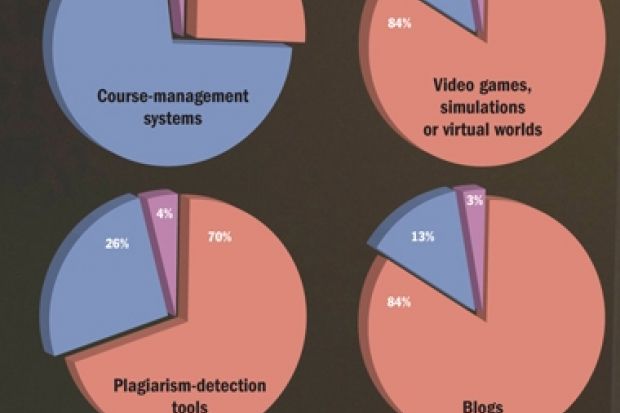
The results show that while 72 per cent of respondents used course- management systems such as Blackboard, many did not use any other technology in their academic lives.

Some 70 per cent did not use plagiarism-detection software and 84 per cent did not use blogs. In each case, a small percentage claimed not to know that such things existed (see graphic, below).

The use of technology in higher education is becoming a political as well as an academic issue in the US; the Office of Educational Technology, part of the Department of Education, has published a draft of its National Educational Technology Plan 2010 calling for "revolutionary transformation rather than evolutionary tinkering" in the field.

Mark Greenfield, director of web services at the University of Buffalo and a higher education web consultant, said that although the Indiana survey took responses from a small sample of universities, the findings were an accurate reflection of the sector as a whole.

"I think there is a faction of faculty that is resistant to this kind of change," he said. "There is a sense that students need to adapt to their style rather than vice versa."

Writing for Times Higher Education in 2006, Terry Eagleton, distinguished professor of English literature at Lancaster University and visiting professor at the National University of Ireland, Galway, championed Luddite attitudes in the academy and said that an excess of information had led to academics "being robbed of the most precious medium of reflection, which is time".

Edward Tenner, author of Why Things Bite Back (1997) and Our Own Devices (2003) and a visiting scholar at Rutgers and Princeton universities, said it was "very possible" that teaching or scholarship would improve if more academics used technology. However, he agreed with Professor Eagleton that the time it took to learn about technological advances could impinge on other areas of scholarly life.

"If an academic invests their time in mastering this or that computer program, they are spending less time on something else," he said. "So many are sceptical that these particular things are worth their while when they could just do their research instead."

Professor Tenner added that researchers will often be so immersed in their field that they will not feel the need to use technological tools to help them find academics and papers in areas related to their own, but he questioned whether this was a sensible attitude to adopt.

"If someone isn't making full use of a tool, even if they don't need to in their work, is it really fair to students if they can't help them learn to use something that, for the students, is essential?" he asked.

Mr Greenfield said faculty should be more willing to "move outside their comfort zone", but added that universities had responsibilities, too.

"I am always amazed when I talk to faculty about how antiquated some of their computing equipment is," he said. "On some campuses, there are programmes that help faculty to use technology, but they are too small. There needs to be a lot more support and resource in this area."

Professor Tenner said the "mental effort" required by staff who had been "educated in an age of information scarcity" and who were now "adapting to an age of information abundance" made the adoption of technology in the academy difficult.

However, Mr Greenfield said it was essential that this was overcome before countries such as the US slipped behind their more technologically savvy rivals.

"We need to do a better job of educating our students," he argued, "and one of the best ways we can do that is by embracing new technology."

sarah.cunnane@tsleducation.com


TECHNOLOGY IN US UNIVERSITIES

Readers' comments

  • Carrie Rostron 12 August, 2010

    Interesting pie charts. I see there are two options for not knowing about it, and one for using it.

    There are no options for I've looked at it, considered how it will help students to learn about my subject and rejected it as being a gimmick or having nothing to offer beyond my current methods.

  • con murphy 12 August, 2010

    With all such articles, ultimately championing technology, we receive an inordinate amount of 'opinion' and suitably massaged statistics about the benefits of technology in education, and the apparent caveman-like positioning of anyone who holds a different position. This is both intellectual bullying and ironic in that it essentially offers up a poor intellectual process - i.e. there is a heavy emphasis on one particular perspective, supported by 'experts' whose opinions are clearly based on self-interest. Tecnology in education is a method, not a god-like solution to the development of mankind. This article is written in the same tired pattern.

  • Bee 12 August, 2010

    They're resistant using new technologies because they don't know what it's good for and don't know how to use them. You gotta tell them what a blog is and what it's good for, how else can you expect them to see the benefit?

  • JustAnotherComment 12 August, 2010

    I'm sure I'm just being a bit thick, but can someone explain to me the connection between the statements

    "social media has overtaken pornography as the number one activity on the internet"

    and

    "However... the academy may be failing to capitalise on the potential offered by new technology".

    To illustrate the problem I'm having, I offer the following alternatives:

    "Hammers: the number one tool in DIY, but are academic utilizing hammers and hammer related paraphenalia to their full potential?"

    "Drinking white lightning in a windswept bus shelter has overtaken Morris Dancing as the social activity of choice for a large proportion of teenagers. However, is academia using cider to its full potential?"

  • Bee 12 August, 2010

    Actually: In the text you write 84% of do not use blogs, but in the figure caption it says 84% have never seen a blog, which one is the right one?

  • Our Eli 12 August, 2010

    Yet another piece of silly season 'filler' concocted out of headline results from some 'survey' or another (cf the PA Consulting 'survey' of VCs a week back). Have the people at THE nothing better to do with their time? Are there not pressing issues in UK academia rather more important than this one?

  • THE 12 August, 2010

    Bee - 'never use' is correct. The key in the graphic is being changed forthwith. Apologies for the error.

  • Bland Tomkinson 12 August, 2010

    The evidence so far is that gains from the introduction of technology tend to be associated with a complete revision of thinking about the teaching and learning involved. It is not the simple act of introducing e-learning that produces the benefits, it is the act of reviewing and reflecting on what needs to be learned and how. When academics are already hard pressed to teach much larger classes and provide meaningful individual feedback to every student it is little wonder that the reviewing and reflexion tends to get put on a back burner. It isn't that we are Luddites, its simply that we don't have the time to work on making effective change.

  • Emma 12 August, 2010

    I'm generally the sort of person who does use technology; and have used all of the above & more with students. However, I also agree with Carrie's point that they didn't also ask those who don't use them what their reasons were.
    (I'd also love to know how many of the bloggers/virtual world users are using them, and *not* the institutional VLE - as they find that the former let them do much more of what they want with their students than the constraints that some VLEs put on users.

    I'd like to see a time, hopefully in the not too distant future, where using a blog / whatever (not plagiarism detection software, as I think that's a different matter) - is seen as just part of the range of things available - along with the books / videos / images / models the lecturer is using - they're picking the best thing for the aspect they're teaching at the time. Next week, it might be something different to meet the needs of different students/ a different aspect of the subject / etc.

  • Our Eli 12 August, 2010

    What I'd like to see is some randomised controlled trials to see whether or not any of this stuff actually makes a real difference. Some hope there.

  • Emma 12 August, 2010

    Agree with our Eli - though, of course, the difficulty of doing any randomised controlled trials is ensuring that the lecturers don't change anything else & also exhibit the same level of enthusiasm for all the different approaches; it's so easy when you introduce one new thing to get increased motivation for the whole course & change quite a few things at the same time.

  • Conversely... 12 August, 2010

    While I agree with Emma's statement, it's also easy, when forced to do something you don't want to do, to lose enthusiasm in a lot of different ways.

  • Stuart Watt 12 August, 2010

    Opposing technology for its own sake is almost exactly as pointless as campaigning for its introduction for its own sake. There are many roles it can play, with different beneficiaries. For example, technology can be student-facing (e.g., assessment), tutor-facing (e.g., tracking), administrator-facing (e.g., evaluation), and institution-facing (.e.g, central administration systems). Classing these together is unhelpful.

    Student-facing technology is *hard* to assess using randomised controlled trials, simply because people know what's going on. That removes the controlling element straight away. Alternatively, try it, and ask the students. It's easier to do that, and if they like it and want to use it, it's probably adding something to the learning experience. I don't need to do a randomised controlled trial to decide I like my iPod or want to download podcasts. And no amount of statistical evidence would convince me if I personally didn't like it.

    In my experience, the problems with technology are (a) limiting beneficiaries to those funding development (typically institutions), (b) limited imagination about the ways it can help make a tutor's life easier, and (c) in some cases, really bad interaction design which can destroy all potential utility and annoy everyone immensely.

    For a member of faculty, the problem is almost never technology - it's learning to engage with students, and help them learn more effectively. If technology helps, use it. If it doesn't, don't. But don't assume that your students aren't using technology - they probably are. And don't avoid it because you are concerned about having to learn new skills - after all, you should be doing that anyway.

  • buggerlugs 13 August, 2010

    Call me a grumpy old man, but I want my students to engage with 'old' technology - books, journal articles, conference proceedings, face to face discussions in real time, learning to think on their feet...too often 'new' technologies get reduced to gimmicks and wikipedia - I want students who can operate the tool between their ears (another piece of pretty old technology)...

  • Michael Hargreaves 13 August, 2010

    As a university educator in Australia and founder of WriteCite.com I find that student awareness of technology solutions for education is very high, paricularly in the US. However, student adoption of technology for non-socila purposes is a different thing. There is the expectation that educators around the globe adopt new technologies. For those of us fortunate to have access to new technologies we find ourselves teaching these skills as well as course to students and therefore we, as well as our students, are not luddites. Rather, we are selective on the technologies we use for education purposes.

  • Michael Pyshnov 13 August, 2010

    I don't know how you teach social sciences. But, in teaching science use of technology MUST follow this rule: absolutely bare minimum of technology. You can tell a good teacher by the amount of technology he has disposed with.

    In science, an explanation must show the phenomenon in its elementary form, and show that the phenomenon is INVARIANT of a number of parameters. Example (since I believe that the above phrase is not the best description of what I mean):

    You want to explain that the water in the vessels connected with each other will be on the same level. You, when students are watching, draw on the blackboard the vessels of odd shape with uneven walls and crooked connections. You draw the horizontal line - the water level. They see that the level of water is INVARIANT of the shape of the vessels, etc.

    If you introduce any "technology", the essence of the phenomenon will never be as clear. You can make a movie from a computer animation, in which the vessels change shape before your eyes but the water is still on the horizontal line everywhere, yet, some students (THE BRIGHTER ONES) will believe (AND JUSTLY SO) that it's because the computer made it this way.


    In the good old times, the galvanometer showed the students its full scale and a moving arrow. Trust me on my word, it was teaching science eight and a half times better that the new digital thing. (It is even better if students make a CRUDE equipment themselves.)

    Any thing that stands between the professor with his blackboard and the students with their eyes and brains, must be removed. And that includes the Office of Educational Technology.

  • Caron Dann 13 August, 2010

    I enjoy using new technology, especially with media studies students. However, sometimes it is difficult to incorporate new technology - not because I can't or won't use it, but because the university simply does not have it. I have been given classrooms with nothing but a white board - and that's to teach media studies students. I was expected to lecture and tutor a Master's class last year that also had off-campus students, in a classroom not equipped to record seminars. I ended up buying equipment and recording the seminars myself. The lights, projectors, microphones and other equipment are constantly breaking down. We just received notice about a study of academics using new technology such as iPads in classrooms. I can assure you, they would be providing this technology themselves. The university itself is a Luddite - or just a Scrooge. It's not just universities. I spoke at a conference this month that had a make-shift set-up for PPT presentations with a mini-computer and an old wooden lectern; there was no internet access. This event was at a new, supposedly state-of-the-art conference centre for literary-related events attached to the State Library. They don't even have a wi-fi hot-spot there.

  • JC 13 August, 2010

    I was one of the first academics at my institution to trial video podcasts of lectures, and using audio files to deliver more detailed feedback on assignments etc.

    While trying out these "new technologies", I conducted a survey of students about how they used these resources, and their attitudes to learning.

    Guess what - the students all prefer "live" lectures to podcasts, for example, and they gave a wide variety of reasons *against* widespread use of blogging and all the rest of the "social media" bandwaggon in the delivery of their education.

    I'm far from a Luddite - I was an "early adopter" - but now I use those resources very sparingly indeed, because there is frankly no substitute for excellent, face-to-face teaching. *That* is what the students expect in return for their fees - and I increasingly think that is still actually all they need, if it is done well.

    I guess I should publish the results of my survey in one of those flaky education journals - but unfortunately I'm too busy doing my "real" reseach.

  • Sonja Grussendorf 13 August, 2010

    @JC - your comment would be so much more acceptable if it weren't for its immoderate tone/ dismissive attitude of educational research as flaky and "unreal". It leaves me wondering why you conducted the survey in the first place, was it just for a laugh?
    As to the finding that all students prefer live lectures I am not sure why you expect this to surprise anyone - what surprises me however is your underlying assumption that others think of these new technologies as *substitutes" to "excellent, face-to-face teaching". They are not meant to replace teaching, they are meant to support it, or to enable that type of teaching that is not *yet* done well. As a non-luddite and an active researcher on "real things", I would expect you to give those who investigate the use of such technologies that much credit: that they are not interested in these technologies for their own sake, but for their educational potential.

  • Myron Bolitar 13 August, 2010

    "Can we not have before again, can we not" ('Road': Cartwright, J)

  • Janni Aragon 13 August, 2010

    Some of the issues that I hear from colleagues, who are resistant to the technologies, vary from having to learn the new platforms or tech and not wanting to make themselves more available to students. I cannot understand either statement.

    I agree with the poster about journals, books, articles and venturing into the library, learning centre, are important, but we can still use some of the new tech to teach. And, the new platforms and software will "hook" some students in the process.

    I originally found this article on Twitter. It was posted by @FindAPhD

  • Richard Armstrong 13 August, 2010

    My experience is somewhere between buggerlugs and Caron Dann's. The VLE that my university has is not used properly by lecturers because it is a horrible piece of software. In fact, the only two things that lecturers do regularly are announce things (reminder for essays to be submitted or if a classroom has been altered, for example) and upload material from class. Only one member of staff (she left after my first year) allowed us to submit work and sign up for presentations (i.e. use more features of the VLE) etc., etc..

    The problem with technology is that it is too often seen as something that can replace specialised content rather than facilitate it. I honestly do not care how well developed an IT solution is if the university does not have a subscription to the journal I need access to. Likewise, while I would advocate a centralised paperless system (on the student's end) for essays etc. which all staff could access (would mean feedback and essays could be reprinted if anything was ever lost or you wanted to cross-reference a students marks/work when externally marking etc.), I would never advocate the use of podcasts in place of lectures as JC rightly pointed out.

    Some things are done brilliantly – COPAC, for example – but others are terrible – EthOS, for example – for both technological and end-user issues; I submitted a thesis request online to Bristol on 22/10/09 and the British Library eventually cancelled this request on 11/06/10 because the thesis was never received (because of insufficient funds...?). Some universities basic library and electronic resource systems are so bad it is often easier to go and have a wander round the library or talk to your lecturer...

  • Hero 14 August, 2010

    This is fun, watching academics flap about trying to denigrate the new learning tools - I wonder if Plato would have gone mental burning books when he saw them! there is a very real risk that academics will be superceded by knowledge sources that aren't stuffed full of prejudice, personal likes and dislikes and contempt for people without public school table manners - poor them - Aspic anyone??

  • buggerlugs 14 August, 2010

    Quote from Hero: "There is a very real risk that academics will be superceded by knowledge sources that aren't stuffed full of prejudice, personal likes and dislikes and contempt for people without public school table manners"

    Really Hero? If academics will be 'superceded' in your brave new world, then who or what will produce the 'knowledge' for these new 'sources'? Who or what will draw on the most up to date knowledge and rigorous thought in order to create them? Who or what will the expert reviewers be that check these 'sources' in order to ensure that they actually contain something worth teaching? - or will it be merely a case of "we're going to teach students a lot of ill thought out, unsubstantiated, vacuous shit, but hey we have a shiny new tool to teach it with!"

  • To Hero 14 August, 2010

    @Hero the zero. Sometimes it is wise not to comment. Ever learned this?

  • Herbert 15 August, 2010

    Is it merely a truism that all the new media technologies are associated with a decline in the ability of students to work with complex sentences and ideas? I am under the impression that there is truth to this. I don't mind the use of new technologies as ancillary aids. But I am not ready -- doubt I will ever be ready -- to give up on the notion that students need to become comfortable reading books and listening to complex arguments delivered in lecture. "If you can't beat 'em, join 'em" doesn't seem like a very promising pedagogy to me.

  • Caron Dann 15 August, 2010

    Hero - Plato was totally against writing and used the same objections as are used today against new technology. In Phaedrus and in the Seventh Letter, Plato said writing would destroy memory, would weaken people's minds and could not possibly take the place of a person because written text was inanimate. Then in 1477, Hieronimo Squarciafico argued that 'abundance of books makes men less studious' (Ong, Walter 1982 in Orality and Literacy: The Technologizing of the Word, pp79-81).

  • To Herbert 15 August, 2010

    In my experience , there is a correlation between the use of new technologies and the reputation of the universities concerned. Most of the so called new technologies are used very widely in the post-92 universities where the academic background of students is comparatively very weak, their attendance to lectures and tutorial is shockingly low and even those who attend do not take active part in discussions. In these universities where the number of non-EU students are very high, the language becomes a problem for them to take part in rigorous discussions coupled with their weak academic background, although their high achieving compatriots in top universities do not seem to have these problems. I agree that these so called new technologies can at best be aids, but are used as substitutes to present lectures to overcome the issues with high percentage of abseteeism from these non-EU students who work more than 20 hours per week and lectures come second, who can it is assumed use these technologies when and if they " feel" like dipping into lecture material.

  • Hero 16 August, 2010

    I'm pleased to see that despite the outrage, people accept that academics are largely prejudiced and stuck in ideas of public school behaviour being a mark of intellectual ability.

    As for 'To Herbert' I'm pleased to see that the most idiotic views are lain down by the most prejudiced posters - check your figures better on spend on new technologies you utter utter fool.

  • Michael Pyshnov 16 August, 2010

    I think that voting for or against "technology" is, in any case, a diversion. It so often happens that no one thinks further than answering a question; and the question happens to be stupid.

    The real question is what content is delivered. Why books are better? Just because their content is better; but the content of the new technology is probably stupid. Why stupid? That's because the technology offers an quick way of cooking a content that will fill the screen and fill the time.

    Has any technology presentation been translated into, say, five languages? None?

  • Theresa 16 August, 2010

    To state the obvious, technology is simply another potentially very useful tool that tutors can use for teaching, in a myriad of different ways and which most modern students are familiar with. The trick is to use it appropriately when it adds pedagogic value and it is therefore pedagogically useful to do so.

    There is also one other reason for using it though - it allows institutions to more easily meet their duties under the Disability Discrimination Act.

  • Paul H 16 August, 2010

    As someone who uses TEL extensively, I am surprised that no-one has brought up one of the major issues that I have found with using technilogy - the students themselves. Having carried out several studies on this now, I have consistently seen a sizeable minority of students who either can not or will not engage with TEL.

    This then leads to a high level of redundancy, with academic staff having to duplicate work in a TEl and non-TEL format - and as we all know, there simply is not the time to do this! Faced with only being able to produce schemes that will either be used by 100% or 80% of students, we are quite naturally going to try to include as many people as possible in the learning process.

    As usual, we get a 'blame the academics' piece. Whilst this may be true in some cases, I would suggest that the role students play in their own learning also needs to be looked at as it plays just as big a part in hindering the use of technology.

  • To Paul H 16 August, 2010

    If that's really all there is to it - these are beneficial technologies, and the staff are willing to use them, but some of the students won't - then we should really be blaming the system that requires high pass rates.

  • Hero 16 August, 2010

    Hi Caron,

    Thanks for your answer about Plato and other scholars' resistance to 'new technology - I loved that you knew this! It was a good illustration of the point as well, but delivered without explaining the point - if only I could be so disciplined!

    I would like to point out that there is some value in the creative responses to my percieved 'attack' - academics and educationalists AREN'T making enough of the fact that teenagers are sitting around philosophising in bus stops wasted on white-lightening, academics may not be in the position where they are funded expert gatekeepers in the future, and where else do you think new interpretations and developments come from anyway if not from younger intellectuals enstering the debate.

    Whats really concerning is that in other professions - legal professionals, surgeons GPs and health professionals, retail professionals, librarians, marketing professionals etc all members are required to be up to date with new practices and new delivery mechanisms as well as the changing requirements of their customers. This ivory tower, men in capes BS that excuses lazy senior academics just isn't on any more - now that access to information is so wide, the beard-stroking of those who have access to information no-one else has should be left in the fairy tales and history books it came from. We are in a hard-assed, fast-delivery, fast-moving environment now and if you can't cut it - step aside a bit

  • To Hero 16 August, 2010

    You cal To Herbert a fool. But you are a moron whose verbose rant means nothing and you are rightly called Hero the zero.

  • To Hero 16 August, 2010

    The purpose of an education is not to "deliver" facts, but to develop the student's mind. Students are not "customers" - they may know what they want, but they do not always know what they need. Some of these technologies may be good if they help students engage, and force them to think more, but an awful lot of these technologies are ways to make it easy not to think. It's important for students to spend time in the library sifting through an excess amount of information in order to learn how to separate the wheat from the chaff. It's important for them to do their own maths, instead of pumping things through computer algebra programs and calculators, because sometimes the process of getting to the answer leads to some insights. I could go on, but I hope my point is clear from a couple examples. It's true that "Luddites" in the past have overstated the damage from new technologies, but it's also true that they had legitimate points. Anyone who has seen the science that came out of China ten years ago, where the only real contact with foreign expertise was through reading journals, and has compared that with science in China today, where there are more and more Western-educated scientists will realize that Plato had a point. Books can be great, but there are common fallacies that haven't been written down, sometimes because they are hard to write down, but which can be taught through personal contact. These were once routine in Chinese papers, and are gradually becoming less common. Technology can augment traditional teaching methods, but it is important to use conservatism in bringing them in. This isn't laziness, but rather carefully thought out stubbornness.

  • Aeon flux 17 August, 2010

    The usual, im against change crusty hubris. If you dont like change, better look for a time machine. Students are paying and therefore have a right to be provided with learning the reflects contemporary society. Yet again, the academic art of splitting hairs surfaces. Bottom line, get with modern life.

  • Michael Pyshnov 17 August, 2010

    Hero: "We are in a hard-assed, fast-delivery, fast-moving environment now..."
    This is true. But I think it's very bad. This is the cause of superficiality and basic illiteracy. A loss of knowledge is stunning. In cancer research and adjoining areas people were moved by new technologies to molecular research, but they are lacking the knowledge of biological phenomena. These studies do not lead to the understanding of the phenomena and the laws of nature. They only might give the answers when the last molecule, its location, its history, etc. is traced and the complete picture is drawn and understood, which will never happen.

    The success of science never depended on complete knowledge. If it did, there wouldn't be any success in the past. The success depends on the ideas penetrating to the right level on which the particular phenomenon is taking place. You cannot derive all the equations in nature from the hydrogen atom upward. A spectacular failure we are witnessing now is with finding so-called cancer genes and having absolutely no clue how to apply this knowledge which by the way can also prove faulty. That, basically, was the mistake in placing all hopes with technology.

  • Hero 17 August, 2010

    sooo.. the detractors seem to think that the Chinese had a verbal-only culture until recently and that 'better' science comes from pencil and paper or mental maths?

    Get with the programme idiots. Mathematical modelling in science and engineering is impossible on paper. You seem to think that sifting through vast amounts of information is inherent to the development of study skills, yet are weirdly against using new technology to deliver that information, help analyse it or record patterns in it!

    Again I am pleased that those against are demonstrating their stupidity so effectively - it almost leaves me out of a job!

  • Reading comprehension 17 August, 2010

    No, Hero, you have, in fact, proved my point. There are a lot of people with poor reading comprehension skills who think that everyone else should give them bulletpoint lists. I'll try to bring this down to your level, but I suspect you're not interested in serious debate, but just in complaining about people who know more than you do refusing to listen to you.

    China was closed off for quite a long time. When they re-opened their universities, there was no tradition of science in them. People tried to learn purely from books, and generally got things about 90% right - i.e. just good enough to write papers with serious misconceptions in them. In the past few years, there have been more and more Chinese scientists who have returned after having spent time in more scientifically advanced countries, and learned the subtleties of what's really going on through face-to-face interactions, for which there is no substitute.

    As for mathematical modeling - of course it's important to do this with computers - but you can't skip the step of doing things by hand as a learning experience, or you end up seriously lacking in the judgment to assess when things have gone wrong.

    As for sifting through information - I'm referring more to the idea that a lecturer should prepare a web page or VLE page with only the "relevant" information for a course, rather than telling students to go through the library and find things. This is what most students want when they say there should be more technology used. What they really mean is that they want a short-cut to giving a superficial appearance of knowledge. Sure we should show them how to sort through library collections electronically, but that is a 15 minute job to do, and really, any student should be able to teach that to himself.

  • X5 17 August, 2010

    Hero: yawn...

  • Godfrey 17 August, 2010

    Hello,

    I work for a top research environment and I hate all this paperless secure documentation. When I was in charge of things a poor or 'undesirable' candidate's file could be lost, or incriminating documents removed from the student's file by the supervisor. Now supervisors have no control over what is held. Similarly with personnel files - when i was getting sick of a junior i could have my secretary pass me files for 'pruning' to make sure an either positive or negative picture was painted depending on whether I wanted to manage them in or out. Now its all e-mails and double copies a massive chunk of my academic authority has been lost and the power shifted to people who shouldn't really decide the agenda

  • Paul H 18 August, 2010

    @ Godfrey.
    The solution is to avoid mentioning anyone by name in emails or electronic documents. Everyone should have a good nickname ;-)

Disclaimer: All user contributions posted on this site are those of the user ONLY and NOT those of TSL Education Ltd or its associated trademarks, websites and services. TSL Education Ltd does not necessarily endorse, support, sanction, encourage, verify or agree with any comments, opinions or statements or other content provided by users.

Comment on this story

Post your comment

You must fill in all fields marked *

12 August, 2010


Please note: By adding a comment you confirm that you have read and agreed with the code of conduct under our Terms & Conditions. Comments posted on timeshighereducation.co.uk may be moderated.

Main site navigation:
Secondary site navigation:
Main site navigation end
-
 
-
Abacus E-media
Abacus e-Media
St. Andrews Court
St. Michaels Road
Portsmouth
PO1 2JH
-

Advertisement