If Socrates were alive today, I can't help but wonder what he would think of the muddle that seems to be the human species. Considered a thinker par excellence, Socrates sought reasonable and logical ways to approach issues and problems. Ever in search of rational ways of living, he tried to help others do the same. Believing that education should lead to a deeper and more coherent world view, and that people need to develop skills and habits of thought to reason well through life's myriad problems, he continually pondered how the examined life could be achieved.
It is safe to say that we have strayed a good distance from Socrates' vision of education, not that his vision has ever been realised in any significant sense in human cultures. And although he knew full well that critical or rational societies could not be readily or easily achieved, I think even he would be shocked at how far removed we are, still, from achieving the world he thought might be possible. To put the point more succinctly, two millennia after Socrates' death, we are worlds away from systematically embodying his ideas, either theoretically or practically.
There has never been a more important time in human history for the pursuit of Socrates' vision. As the world becomes smaller and smaller, with more and more people vying for fewer and fewer resources, the importance of working towards the critical societies conceived by Socrates becomes increasingly more apparent. Socrates was hoping for something better than the narrow pursuit of vested interests so common among human groups today. He thought that people could and should participate in the creation of reasonable, just societies, and that the development of the individual mind was essential to the rational pursuit of knowledge. He thought the goal of education should be to teach so that students learn to value the importance of living an examined life. He believed that education inherently entails the seeking of truth, wherever that truth might lead you. And he was especially concerned with the problem of sophistic thinking - skilled thinking designed to serve selfish or vested interest, or in other words unethical critical thinking.
Why then, more than 2,000 years after Socrates has come and gone, are we still so far from the realisation of critical societies? I think the short answer is that although humans naturally reason, we don't naturally reason well. We don't automatically and effortlessly reason with skill and discipline, with concern for the rights and needs of others, with intellectual humility and integrity. And we aren't doing enough to move in this direction. What we are doing is hit and miss, scattered bits of logical thought and action, but not enough to create a reasonable world.
At the same time, we think our thinking is fine. To detect problems in our thinking requires that we concern ourselves with the problematics in thought. It requires understanding the mind, where and how it tends to go wrong, and how we can intervene to set it right when it does.
In essence, we need the tools of critical thinking if we are to effectively cultivate the Socratic spirit, for it is through these tools that we can emulate the best thinking of Socrates. To understand the relationship between the Socratic method and critical thinking, a good place to start is through analysing the Socratic dialogues themselves, for a close examination reveals the concepts and principles, skills, abilities and traits of critical thinking. Consider the following few examples from Plato's Socratic dialogues:
Socrates routinely delineated important concepts by focusing disciplined inquiry on such questions as:
"What is justice?" (the Republic)
"What is courage?" (the Laches)
"What is knowledge?" (the Theaetetus)
"What is piety and what is impiety?"
(Euthyphro).
Socrates focused on keeping the thinking of others relevant when they seemed to be wandering from the question or deliberately avoiding answering the question:
In the Theaetetus, Socrates asks "What is knowledge?" And having been told that it is geometry and shoemaking and so forth, he replies, "You were not asked what things there is knowledge of, nor how many sorts of knowledge there are ... for our aim in asking was not to count the sorts of knowledge but to know what knowledge itself is."
Socrates asks Euthyphro to tell him the meaning of piety, and when Euthyphro strays from the question, Socrates replies with: "just at present I would rather hear from you a more precise answer, which you have not as yet given, my friend, to the question, What is 'piety'?"
Again, when Euthyphro strays from the question, Socrates attempts to keep the thinking on track: "Remember that I did not ask you to give me two or three examples of piety, but to explain the general idea which makes all pious things to be pious."
Socrates displayed and encouraged intellectual humility:
When Euthyphro says he knows how the gods behave, Socrates says, "as you who are well informed about them approve of them, I cannot do better than assent to your superior wisdom. For what else can I say, confessing as I do, that I know nothing of them?"
In Meno, Socrates says "how can you know whether a thing is good or bad of which you are wholly ignorant?"
Socrates questioned the logic or truth of conventional beliefs:
When Euthyphro details the behaviour of the gods, Socrates says, "And do you really believe that the gods fought with one another, and had dire quarrels, battles, and the like ... as you may see represented in the works of great artists ...? Are all these tales of the gods true, Euthyphro?"
Socrates exhibited and encouraged intellectual engagement and intellectual perseverance:
In Meno, Socrates says "that we shall be better and braver and less helpless if we think that we ought to inquire than we should have been if we indulged in the idle fancy that there was no knowing and no use in seeking to know what we do not know; that is a theme upon which I am ready to fight, in word and deed, to the utmost of my power."
If we want our students to develop the traits and abilities implicit in the Socratic spirit, we can begin by teaching them the concepts and principles entailed in critical thinking. Let us take two sets of critical thinking concepts that, when internalised, lead to skilled questioning: the analysis of thought and the cultivation of intellectual traits or virtues.
The analysis of thought
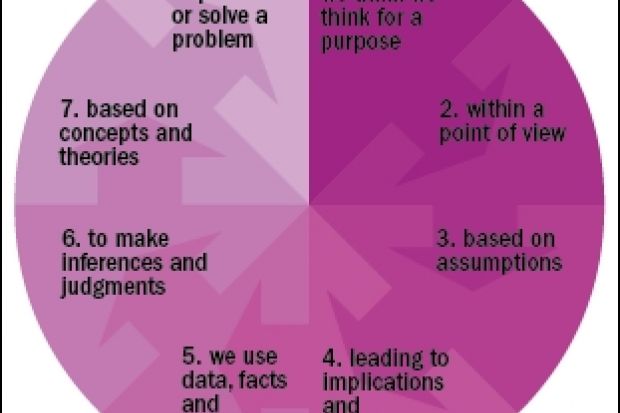
To analyse thinking, students should learn to identify and question its elemental structures.
Note the following powerful questions students can ask when they understand these structures of thought. Of course, many more questions can be generated when the elements of reasoning have been internalised.
1. All reasoning has a purpose.
Can you state your purpose clearly?
Is your goal realistic?
Is your purpose justifiable?
Should you be pursuing a more important purpose?
2. All reasoning is an attempt to figure something out, to settle some question, to solve some problem.
What question are you trying to answer?
Are there other ways to think about the question?
Can you divide the question into sub-questions?
Does this question require judgment rather than facts alone?
What intellectual tasks are entailed in this question?
3. All reasoning is based on assumptions.
What assumptions are you making? Are they justified?
How are your assumptions shaping your point of view?
Which of your assumptions might reasonably be questioned?
4. All reasoning is done from some point of view.
What is your point of view? What insights is it based on? What are its weaknesses?
What other points of view should be considered in reasoning through this problem?
What are the strengths and weaknesses of these viewpoints? Are you fair-mindedly considering the insights behind these viewpoints?
5. All reasoning is based on data, information and evidence.
To what extent is your reasoning supported by relevant data?
Do the data suggest explanations that differ from those you have given?
How clear, accurate and relevant are the data to the question at issue?
Have you gathered data sufficient to reach a reasonable conclusion?
6. All reasoning is expressed through and shaped by concepts and theories.
What key concepts and theories are guiding your reasoning?
What alternative explanations might be possible, given these concepts and theories?
Are you clear about the concepts you are using in your reasoning?
Are you distorting ideas to fit your agenda?
7. All reasoning contains inferences or interpretations by which we draw conclusions and give meaning to data.
To what extent do the data support your conclusions?
Are your inferences consistent with each other?
Are there other reasonable inferences that should be considered?
8. All reasoning leads somewhere or has implications and consequences.
What implications and consequences follow from your reasoning?
If you accept this line of reasoning, what implications or consequences are likely?
Intellectual traits or dispositions
Socrates was concerned not only with analysing and assessing thought, but also with fostering intellectual traits. Consider the following intellectual traits and some questions that, when pursued by students, cultivate intellectual traits or virtues:
Intellectual humility is knowledge of ignorance, sensitivity to what you know and what you do not know. It means being aware of your biases, prejudices, self-deceptive tendencies and the limitations of your viewpoint. Questions that foster intellectual humility include:
What do I really know (about myself, about the situation, about another person, about my nation, about what is going on in the world)?
To what extent do my prejudices or biases influence my thinking?
To what extent have I been indoctrinated into beliefs that may be false?
How do beliefs I have accepted uncritically keep me from seeing things as they are?
Intellectual empathy is awareness of the need to entertain views that differ from our own, especially those we strongly disagree with. It is needed to accurately reconstruct the viewpoints and reasoning of our opponents and to reason from premises, assumptions and ideas other than our own. Questions that foster intellectual empathy include:
To what extent do I accurately represent viewpoints I disagree with?
Can I summarise the views of my opponents to their satisfaction? Can I see insights in the views of others and prejudices in my own?
Do I sympathise with the feelings of others in light of their thinking differently than me?
Intellectual integrity consists in holding yourself to the same intellectual standards you expect others to honour. Questions that foster intellectual integrity include:
Do I behave in accordance with what I say I believe, or do I tend to say one thing and do another?
To what extent do I expect the same of myself as I expect of others?
To what extent are there contradictions or inconsistencies in my life?
To what extent do I strive to recognise and eliminate self-deception in my life?
Confidence in reason is based on the belief that one's own higher interests and those of humankind at large are best served by giving the freest play to reason. It means using standards of reasonability as the fundamental criteria by which to judge whether to accept or reject any belief or position. Questions that foster confidence in reason include:
Am I willing to change my position when the evidence leads to a more reasonable position?
Do I adhere to principles of sound reasoning when persuading others of my position, or do I distort matters to support my position?
Do I deem it more important to "win" an argument or to see the issue from the most reasonable perspective?
Do I encourage others to come to their own conclusions, or do I try to force my views on them?
Intellectual autonomy is thinking for oneself while adhering to standards of rationality. It means working through issues using one's own thinking rather than uncritically accepting the viewpoints of others. Questions that foster intellectual autonomy are:
To what extent am I a conformist?
To what extent do I uncritically accept what I am told by my government, the media, my peers?
Do I think through issues on my own, or do I merely accept the views of others?
Having thought through an issue from a rational perspective, am I willing to stand alone despite the irrational criticisms of others?
At present we are a world away from the Socratic ideal. How many people are in prison across the globe for questioning the status quo? How many people throughout history, like Socrates, have been put to death for challenging authority or power? To what extent is conformity (or mob-think) a problem in human societies? How many classrooms are places where freedom of thought and speech is encouraged and expected? What are we doing in today's societies to move towards the Socratic model? It seems to me that until we take our thinking seriously as an object of thought, until we begin to question our thinking in earnest, we will continue to limp along, moving closer, and then further away, from the Socratic ideal, the cultivation of fair-minded critical societies.
Register to continue
Why register?
- Registration is free and only takes a moment
- Once registered, you can read 3 articles a month
- Sign up for our newsletter
Subscribe
Or subscribe for unlimited access to:
- Unlimited access to news, views, insights & reviews
- Digital editions
- Digital access to THE’s university and college rankings analysis
Already registered or a current subscriber? Login