My THELoginRegister
Third Level Navigation:
09 February 2010

Advertisement

Advertisement

Advertisement

-
Main Page Content:

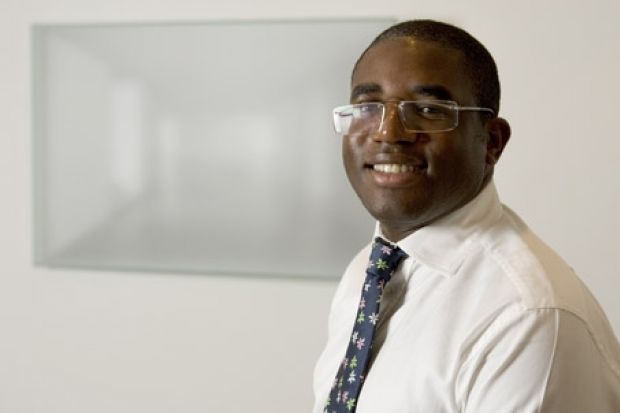
Lammy demands ‘further and faster’ progress towards economic impact

10 September 2009

Higher Education Minister also tells UUK conference that sector must bring in more private cash. Phil Baty reports

The higher education funding system is set to be reformed to ensure that universities make a greater contribution to the UK’s economic needs, it was announced today.

David Lammy, the Higher Education Minister, told the Universities UK Annual Members’ Conference in Edinburgh: “We are working with the Higher Education Funding Council for England to look at how we can develop the funding model to help the sector further increase its economic contribution.

“That may mean making a larger proportion of funding contestable. But that raises important and complex questions, and our thinking on it is still developing.”

He told the audience of vice-chancellors that the Higher Education Framework for the sector’s future, due to be published this autumn, will “ask you to move further and faster down the path you’re already on towards greater emphasis on economic outcomes”.

He also stressed that the research excellence framework, the forthcoming system for judging research quality and allocating billions of pounds in quality-related research funding, will strongly emphasise economic impact.

“Since these impacts are things that happen outside the academic realm, the [REF] consultation will propose that the panels assessing impact will include a large proportion of the end-users of research – businesses, public services, policymakers and so on – rather than just academics commenting on each other’s work,” he said.

“I want the REF to send a strong signal and give a strong financial incentive for departments to not only do excellent research, but also find ways of helping turn that into impacts that benefit the economy and society as a whole.”

On the future funding of the sector, Mr Lammy said it is “no secret that current levels of public investment are unlikely to be sustainable in future”, and urged universities to attract more private cash.

“[UUK president] Steve Smith spoke earlier about the proportion of gross domestic product that this country spends on higher education being half that spent by the US, and he’s right.

“But spending relative to GDP isn’t just about the Government. Private investment in universities has not kept pace with the huge increases in public spending that the last decade has brought. Any sensible analysis can conclude only that you need to find new ways to leverage more private money into the system.”

On quality, Mr Lammy was scathing about the recent report from the Innovation, Universities, Science and Skills Committee, headed by Phil Willis, Liberal Democrat MP for Harrogate and Knaresborough, which criticised degree standards.

“Personally, I regard Phil Willis’ comments – intentionally made on a Saturday morning to get maximum media coverage – as a piece of political grandstanding rather than a serious contribution to the debate. And I think the facts contradict him at every point.”

But he added that “there does remain a real challenge for you on quality in a consumer-driven 21st century. Even if you aren’t complacent about quality, you sometimes appear to be. I think you have to recognise that and deal with it. This is indeed another area in which you have to get better at telling your story.”

Meanwhile, Steve Smith, president of UUK, said in his speech to the conference that higher education institutions now contribute £55 billion to the UK economy, and have become “essential, not optional, for future social and economic success”.

“We now calculate that our universities generate about 2.3 per cent of UK GDP, and employ 1 per cent of the UK workforce,” he said. “No government, or incoming government, in any part of the UK can achieve its core goals without a thriving, strong university sector.”

phil.baty@tsleducation.com

Readers' comments

  • The view from Wales 10 September, 2009

    And what pray tell, will happen in Wales? Is the UK government working with HEFCW too, or are we to be marginalised yet again?

  • Ruth Davies 11 September, 2009

    Surely universities contribute more than 2.3 per cent to the the UK GDP. If it were not for universities there would be no engineers, scientists, nurses, doctors etc all vital to our economy. Where did Steve Smith of the UUK get his figure from and is it reliable? Perhaps an economist could answer this question for us ? i Another view from Wales

  • Lerner Lone 11 September, 2009

    I love it: "a consumer-driven 21st Century"!! I couldn't disagree more. It was a consumer driven late 20th century; all about commodities. The impact of direct exchange via new technologies that remove the middle-person, and link up producers and consumers *directly* has fundamentally changed the economic dynamic. Get with the 21st Century!!! It is NOT consumer driven; it is *experience* driven (think: interactive media: it's a definition but its also a ethos). And it's the experience (in this case) of higher education. And you (good politicking folks) are missing this key point, and making a mess. . . Tha't th impact: a negative one, produced by ill-informed policies, and ill-considered notions.

  • Damien 11 September, 2009

    I find nothing to do with this debate more horrific than the prospect that Universities are being encouraged to focus almost exclusively on economic impact and outcomes. Some highly specialised and much cherished sectors of higher education are sustained almost solely by public money, generate little wealth and surely have every right to remain so? The speech to me serves simply as a pretext for easing off the funding throttle and asking Universities to deal with the fall out themselves.

  • William 11 September, 2009

    Being lectured to about quality and economic contributions from a labour minister is like being lectured on childcare by Phillip Garrido.

  • Knowledge by the kilo 11 September, 2009

    Ah. It seems only yesterday that the Rt Hon David Lammy was promising an independent inquiry in regard the management crisis at London Met, then a couple of weeks later insisting that the government don't get involved in the management of universities. It seems only yesterday that he was extolling the value of the arts ahd humanities in HE, just before the government awarded monies to the sciences. So the latest Lammyism is the importance of economics in Higher Education, is it? I'm afraid I absolutely agree with both 'Lerner Lone' and 'Damien': knowledge and education are NOT simply commodities, to be bought and sold by the kilo; and the prospect of universities being encouraged to focus almost exclusively on economic impact and outcomes is, indeed, horrific. The speech does indeed appear as a pretext for attempting to shift the responsibility for funding to the universities themselves. However, given previous form on the part of Mr Lammy, I guess its likely that this view will only last a week or two...

  • Dr. Gyro 11 September, 2009

    Psst! - got some uncut knowledge - good stuff - street value a couple of £K - any good?

  • JT 11 September, 2009

    Damien et. al. - those specialised, non-wealth-generating parts of universities which you assume (and it's a big assumption) can't survive without public money can do exactly that! They do so in other systems where government puts little money into them. In fact, they're better off without the interference of government, which also 'crowds out' philanthropic activity. If we've moved from 'consumerism' to 'experientalism' (have we? isn't that consumers wanting more for their money?) then that's an argument for people to be able to chose their experiences free of government interference.

  • Don Quixote 11 September, 2009

    It does seem to me that, like "public" transport policies, the government want to end up custodian of the policies, but offload the costs. This allows them to make all the right noises (we as a party are committed to... etc etc) without getting the criticisms about spiralling costs or whatever, whilst at the same time, taking whatever credit might be knocking around but passing the blame back down to.. well, us, eventually. I also love this idea that there's simply loads of money out there, and Universities simply have to go and tap into it - I thought the whole point this last year is that loads of the money out there has simply evaporated?

  • Victim 11 September, 2009

    It is intriguing to note that Mr Lammy was scathing about the recent report from the Innovation, Universities, Science and Skills Committee, headed by Phil Willis, Liberal Democrat MP. The IUSS Select Committe report was right and proper to criticise degree quality and standard standards. Mr Phil Willis’ comments included within the report were right and proper. How can an honest report be described as a piece of political grandstanding rather than a serious contribution to the debate. The facts alluded to in the report DO NOT contradict the truth but document the reality of the appaling status of the quality and standard of the products the Universities offer. Some of the written evidence included within Mr Phil Willis's report, clearly suggest widespread plagiarism and research data falsification in the School of Sport and Exercise Sciences; Liverpool John Moores University (LJMU). This School, ironically, was awarded the highest RAE rating and the highest teaching quality rating. Substantive, indisputable and complling evidence is available to prove beyond any reasonable doubt that such academic improprities occured at LJMU. Mr Willis's report clearly documented these issues which are in the public interest and the public has the right to know. What is wrong with this. Please read for more details THE articles written by Melanie Newman about these issues.

  • Knowledge by the kilo 11 September, 2009

    ... and what was that rather odd remark about quality? 'Even if you aren’t complacent about quality, you sometimes appear to be'? I think the academic community is anything BUT complacent about quality (as evidenced by - amongst other things - the reader responses on these THE blogs). It is in fact Mr Lammy himself who would appear to be complacent about quality, in his dismissive attitude towards the Willis report, and his prioritisation of the perceived need 'to move further and faster ... towards greater emphasis on economic outcomes'. Never mind the quality, feel the width? As 'William', above, observes, it sounds a little like the Phillip Garrido School of Childcare.

  • Damien 11 September, 2009

    JT - I do not recall suggesting that such sectors are incapable of surviving without public money. My only assertion was that at present, they are sustained almost soley by public money. Suddenly pulling the rug out from under their feet is unlikely to lead to the scenario you describe.

  • Roger 11 September, 2009

    I work in a field in which there is active and successful collaboration with industry but find myself uncomfortable with Lammy's remarks. First, the excellent Phil Willis report on degree standards was well researched and broadly representative of the problem we face - to dispute it is absurd and dangerous (and disingenuous) . Second, its clear that this government has little knowledge regarding how wealth is created via university-industry collaboration. Their approach is quite often to dump a lot of money on scientists and say "create" and "innovate" - within a certain time scale and according to a prescription of what must "created". If only it were that simple. Governments refuse to acknowledge that important projects/discoveries more often than not take place over time scales longer than a government's term of office and are unpredictable. Ignoring this leads to wastage and frustration. However, I suppose that Lammy's outburst isn't of great consequence given the imminence of a new government. Nevertheless it shows (again) a worryingly warped view of the role and functioning of the HE sector.

  • Business Balderdash and Bunkum 11 September, 2009

    More lies from Lammy. Firstly, as pointed out by others, the economic impact of Higher Education is not measurable, but it is considerable. Moreover, the economic impacts are ongoing - we have no idea what is going to drive the economy in the future, so the best we can do is help develop people with the critical capacity to think out innovations that are economically valuable, but more importantly socially beneficial. This is not best done by skewing the funding model 'to help the sector further increase its economic contribution' or by encouraging endless HE-industry collaborations, which just lead to the best science brains intellectually subsidising corporate behemonths (and maybe making themselves a few bucks in consultancies on the side). Nor is it best done by loading the REF panels with 'end users of the reserach' to 'assess the impacts' of research acitivty. What will they assess? Whether UK industry is best served by a new innovation, perhaps.... to make some quick short term profits while the really important blue skies research that would have a better chance of really improving the quality of everyone's lives is sidelined. But the tories will be even worse....

  • Lammy may suck but that's not the half of it 12 September, 2009

    I'm not sure that current developments are specific to Labour (New or Old). The tory governments of the 1980s are more responsible than Labour for the current mess - expansion on the cheap and nationalisation of the system were the hallmarks of Joseph and those that followed him. The tory government that will replace Labour next year will turn things even uglier. Willets and Cameron will open the floodgates for the diploma mills, create greater stratification and insist on even more 'high impact research'.

  • Lammy- Bah! 13 September, 2009

    Lammy, like most politicians, has no personal experience or understanding of HE research. If he did, he would start by correcting the mistakes of the past. Successive governments forced expansion of the HE system by removing direct support to Universities, associating the funding with each student and cutting the unit of resource. Expand or sink. However, this wonderful idea effectively put the subject matter taught in Universities in the hands of teenagers. In order to survive, Universities had to compete with each other to attract teenagers and this led to the proliferation of courses in media studies, sports science, leisure centre management and “furry animal science” (as one of my colleague calls his heavily dumbed-down ecology module). With this, the divergence between the product (the graduates), ongoing academic research and the needs of industry widened drastically. Universities produce many graduates destined for the minimum wage, or who must to undertake further study to make themselves employable, because, perversely, academics cannot teach what is current and of use. The Government should stop whining, provide Universities with funding to do what they do “excellently” and students can apply (or not) for the degree courses that are made available to them. This would at least be a start to fixing the true cause of the problem.

  • I too think Lammy sucks 13 September, 2009

    There is one fundamental point here: Lammy is demanding that we produce more money. This demands is the direct result from the lack of money that the government is facing today -- after one decade of over social spending. Ergo, if the Government wasn't in need of money, they wouldn't be asking. I totally agree that universities cannot be money-driven. unfortunately in this country they are, and that sets them apart from the rest of Europe. Our universities are worse, much worse, although everyone here thinks we're the best.

  • Roger 13 September, 2009

    As mentioned earlier, Lammy's problem is that he pretty much ignores the lessons of history. Many extremely useful innovations have turned up through research which took place in the university sector but which were often unpredictable in their nature and their development time. Unfortunately, the best way to ensure useful innovation is to implement a policy no government would consider i.e. generous funding, a supportive government at arms length, and a lot of failure.

  • mindstorm 15 September, 2009

    David Lammy (and his speech writers) might benefit from reviewing contributions to the "the debate on the future of higher education" initiated by John Denham - http://www.dius.gov.uk/higher_education/shape_and_structure/he_debate The message from business leaders such as Sir John Chisholm, Marjorie Scardino and John Griffith Jones is clear - universities and industry should each stick to what they are best at and work to build stronger links. Chisholm’s paper (pages 12 and 13) provides a couple of interesting case studies illustrating that it can take 15-20 years to recognise the economic impact of research.

  • Don Quixote 15 September, 2009

    It takes even longer to actually measure economic impact - we're still reaping benefits on research done centuries ago...is there some kind of statute of limitation - say "economic impact within x months"? - short termism?

Comment on this story

Post your comment

You must fill in all fields marked *

10 September, 2009


Main site navigation:
Secondary site navigation:
Main site navigation end
-
 
-
Abacus E-media
Abacus e-Media
St. Andrews Court
St. Michaels Road
Portsmouth
PO1 2JH
-

Advertisement