My THELoginRegister
Third Level Navigation:
09 February 2010

Advertisement

Advertisement

Advertisement

-
Main Page Content:

Threat to virtual worlds but silver lining for cloud email

Second Life out as techies embrace cloud email

20 August 2009

Technology 'hype cycle' turns against Second Life and lecture podcasts. Zoe Corbyn reports


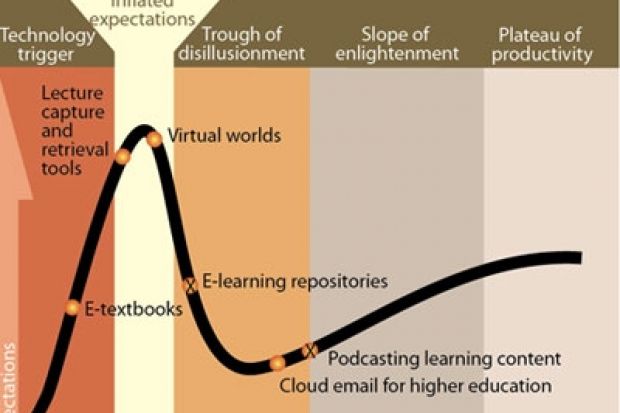
THE HYPE CYCLE FOR EDUCATION,2009


Virtual worlds are about to plunge into a "trough of disillusionment", lecture podcasts are fast becoming obsolete, but cloud computing will soon be on the "slope of enlightenment".

These are the findings of an analysis of the "hype cycle" of technology in education, published by Gartner, an IT advisory firm.

The annual study looks at the popularity of emerging technologies, from internet TV and e-books to microblogging sites such as Twitter, across a range of sectors. It tracks their progression as a function of expectations.

The cycle ranges from over-enthusiasm as technology is hyped, through a period of disillusionment when it fails to deliver, via a slope of enlightenment to a "plateau of productivity", as users learn how best to employ it.

The results for the education sector provide some interesting insights.

Virtual worlds - such as Second Life - have passed their "peak of inflated expectations" and are now set to slide into the "trough of disillusionment".

However, Jan-Martin Lowendahl, research director of higher education strategies at Gartner, said the hype had lingered in the university sector longer than elsewhere.

"Virtual worlds are just starting to come down, but they are coming down much more in the commercial world," he said.

"It is obvious the technology has pedagogic advantages - the question is, how is it going to be established as an infrastructure?"

At present, Coventry University is one of the UK's leaders in Second Life, with a presence that includes an island featuring a harbour, a beach and an amphitheatre.

The hype cycle also signals impending doom for the podcasting of lectures and e-learning repositories, which are forecast to become "obsolete before plateau".

Dr Lowendahl said that podcasting was being subsumed by the more general technology of "lecture capture and retrieval", which is rising quickly up the hype scale.

This is based on recording everything, from the lecture to the marks made on the white board, and then indexing it to ensure easy access for students.

"I think this is one of the areas where IT has the most measurable impact on student retention and grades," Dr Lowendahl said.

Meanwhile, e-textbooks make their first appearance as an emerging technology on the 2009 education curve. In the general hype cycle, which highlights trends across all sectors, e-books are at the height of the peak of inflated expectations.

Cloud email for higher education - free email services offered to institutions by the likes of Google, Microsoft and Yahoo - is also firmly ensconced in the sector.

In 2008, the technology was heading towards the peak of inflated expectations, but this year passed through the trough of disillusionment and is now on the slope of enlightenment.

Dr Lowendahl said the technology had seen a "tremendous uptake, especially in higher education". Although cloud email for the sector was launched only in October 2005, the report, published last week, estimates it has a penetration rate of up to 20 per cent.

"I think it is the quickest uptake I have seen of outsourcing in higher education," Dr Lowendahl said.

The cycle is a global analysis, but focuses on the US and Europe.

zoe.corbyn@tsleducation.com

Readers' comments

  • WebDeveloper 20 August, 2009

    What is both unbelievable and incredible frustrating, is higher education's lack of focus and research towards developing suitable means for digital learning. One could expect these institutions to have enough integrity and knowledge not to just jump on any wave of hype: LMS, Blogs, Wikis, Podcast etc, and after a while find themselves surrounded by more or less useless digital means for teaching and learning. Why are these institutions not developing proper applications for specific learning goals? Why do they, again and again, think that what we have, or can find on the web, is what should be used? Development and design of applications for learning and teaching is an art in it self, and the matter needs to be addressed as such. No LMS so far has ever come close to really enable people to practice a subject, over and over again, like an instrument, to achieve anything but finding the score of the multiple choice test, or its like. The web 2.0 hype was just another hype, and no questions asked, most educators agreed that this would solve a lot of problems. What are they thinking? Fortunately we still are only in the digital stone age, so the future looks bright. Not to mention that the marked for real education related applications is wide open.

  • Jerry Bakewell 20 August, 2009

    That there's a distinction between 'podcasting' and 'lecture capture and retrieval' is useful to recognise, but I still see both as belonging to the same class of endeavour. Podcasting blazed a trail in which the methods for capturing, disseminating, storing and managing this kind of material were developed and widely tried out; 'lecture capture and retrieval' is the mature application of this approach within HE. In this respect, it's a bit like blogging, which has led to some very useful tools and approaches to online study and research, regardless of the good and bad of its uses in the wider world.

  • Erik Duval 20 August, 2009

    If e-learning repositories are forecast to become "obsolete before plateau", and "lecture capture and retrieval" is rising quickly up the hype scale, then I wonder what sort of technology is going to support findability and retrieval of those captured lectures. Will that not be e-learning repositories? Moreover, I think that there are more (or, at the very least, other) relevant learning resources than recorded lectures! Of course, I am a bit biased as I am deeply involved in ARIADNE (http://www.ariadne-eu.org/) and the global network of learning repositories (http://globe-info.org/en/aboutglobe).

  • Greg Withnail 20 August, 2009

    Reading between the lines, I infer that the report mentioned above merely comments on the current perceived position of virtual worlds in an allegedly predictable sequence. It is not claiming that virtual worlds are finished, but that they are at a point other technologies have passed or are yet to reach. (Incidentally, they also say the same about Twitter!) According to another the Gartner report this observation means that such a technology is could be just "some years away from wide-spread enterprise adoption." Anybody with their finger on the pulse could tell you that the trough happened for virtual worlds a year ago and that we are now steadily climbing onto the plateau. Luckily this means I don't have to spend $2000 to buy the Gartner report.

  • WebDeveloper 20 August, 2009

    But why waste time on approaching iTunesU and its like as "digital learning"? Why not dig deeper and realize that, for once, you just cant take any application and adapt it for learning purposes. How would a pilot behave if his simulator really was a train simulator, only with the word "train" swapped for "plain"? This just doesn't work. The same goes for virtual worlds, and other digital means. They _have_ to be specifically developed, and successfully so, for their specific task, and provide seamless interaction between user and learning task. This is not the case in the education world, not even internationally, and is not solved by "providing" lectures, making wikis, or engaging students through web2.0 sites. The edu-world is missing the boat.

  • Dr J Tay 20 August, 2009

    Perhaps virtual podcasts has had its advantages in distance and online universities and the inclusiveness it presents to people who do not have access to basic necessities like libraries and reading rooms. Heck power outages are the rage in some parts of the world. Technology has allowed and equalised the pace of learning between developed and developing world and has enabled those less proficient in the English language to pick up passages to do basic research for their assignments. However, I do see that yes it has helped unis in the West franchise their programs and intranet software to far flung corners of the world and enabled students to obtain data quickly. However, it would depend on how engaged the web administrators are and the online tutors are in delivering what is required. At the end of the day the human touch is still important. Secondly, it allows online universities to be established in emerging markets perhaps in a shophouse or office building. Once this was considered out of the question as traditional campuses were required. Not anymore perhaps it would all be virtual and more interactive.

  • Eric Sotto 20 August, 2009

    I find this article and the comments on it quite remarkable. Not one of the contributors considers whether educational technology is based on anything we know about learning; and not one considers what kind of learning might ensue. There is a underlying suggestion that knowledge is the same as understandiing; and not even a hint of the simple fact that the makers of IT are in it for the same reason as the makers of corflakes. Let me introduce two further considerations into this debate. a) What approach to teaching would favour the kind of technology discussed in these exchanges? And b) What kind of a regime would favour the widespead introduction of IT into education?

  • Derek Rowntree 20 August, 2009

    Technologies for TEACHING (where "teaching" is confused with "delivering information") are clearly running amok. What about the existing technologies for promoting LEARNING that we haven't yet used as well as we might?

  • academic 21 August, 2009

    The last two posters get to the heart of the problem. The best lectures and practicals are ones that capture the students imagination and encourage them to take part and "do" things. Information delivery is important but subsidiary. I kid you not but I have seen a good educator captivate a group of sixty students using nothing but a whiteboard. I have also seen good and novel use of IT but IT is just a tool.

  • Project Manager, Education Software Company 21 August, 2009

    I'd like to know what 'e-learning repositories' actually means (VLE's? ePortfoilios?) and why they think they're going to be obsolete before they reach the 'Plateau of Productivity'. As I'd rather not have to pay the £2k for the report, can anyone help remove my 'Blindfold of Ambiguity'?

  • Liz Falconer 21 August, 2009

    Yes, the popularity and use of education technologies rise and fall like everything else. We adopt technologies that help to enhance learning, blend them with classroom and personal delivery and use our ability as educators and feedback from the students to judge what works best for groups and individuals. We try out new things, keep some and jettison others. But, we know all this already, and referring to this glimpse of the blindingly obvious as a "hype cycle" is both uninformed and patronising. The reality is that we have made good advances in helping students to learn, using all the media and techniques at our disposal, and we will continue to do so. Virtual worlds like Second Life have enormous potential as an environment for simulation of real life experiences to help students to make the connection between theory and practice, (for example see http://www.uwe.ac.uk/elearning/she) and is an educational use that is worthy of development. Also, a recent report (http://tinyurl.com/lhg986) showed that over 600 million children under the age of 18 are users of virtual worlds. 135 million in Habbo alone. They are the future, so maybe we should look at what they are doing now.

  • Eric Sotto 21 August, 2009

    Many years ago, I worked in a large school. This was overseas, and my job was teaching English to youngsters between the ages of 14 to 18. This was a school with a selective intake, and it was affiliated to a well known Institute of Technology. Eventually I made it to head of department, and in that capacity was involved in the introduction to that school of a large language laboratory with highly sophisticated equipment. For example, it was possible for one teacher sitting at an elaborate terminal, to address every student in that class, or for a teacher to encourage students to work on their own at their terminal, and to be in touch with a single student as he or she responded to a tape. As the cost of this project was very large, an informal committee soon came into existence to oversee its implementation. Aside from myself, this included several academics from the Institute, another teacher, the financial director, and several administrators. In due course, the laboratory was up and running; its presence became well known in the area; and it no doubt increased the status of that school. I had mixed feelings about the project, but this was mainly due to my ignorance. In view of the fact that technology was so very considerably easing our lives in many walks of life, it seemed sensible - indeed, almost self-evidently so - to use technology to further the aims of education. At this point, I should perhaps write several paragraphs on how the use of this laboratory progressed, but, in the interest of brevity, I shan't. I will only say that, over the course of the next year or two, it became obvious to all the members of staff who used this laboratory, that it did not live up to our expectations; and the main reason was that the human element, that is so very important in learning and teaching, was missing. As a result, a number of highly motivated students used those laboratories largely to teach themselves, but their general use became increasingly rare, and, by that time I left that school, those laboratories stood empty for much of the week. I began the previous paragraph by noting that I had had mixed feelings about this project, and that this was due mainly to my ignorance. It was only later that I understood the nature of my ignorance. In a nutshell, the problem was that, in those days, I knew very little about learning. But then, it is unfortunately common to this day to think that learning and teaching are almost self-evident activities, and it is rare to come across accounts of the use of technology in an educational setting, written by people who are conversant with the literature on learning, and who have a reasonably viable theory of it. What therefore prompts the introduction of technology into educational settings is, usually, not how it might dovetail with what has been established about the nature of learning, but a general belief that, as technology can be used for washing laundry and mixing cement, and in that way ease our lives, so technology can also be used to ease learning. A very great deal of money is used in this illusionary way, but then, this is only one among the many illusions we all live by.

  • David Hardman 21 August, 2009

    This report doesn't seem to be readily available (I went to Gartner's website and it seems you have to sign up with them, which I didn't particularly want to do), so I don't see what can be usefully said about it. The diagram shown in the THE report is pretty bad as no scale units are indicated on the axes. According to the text, the report is about the "popularity" of various tech tools, but I'm unaware of any other evidence that there are fantastically high expectations about virtual worlds, as indicated in the chart. A report published earlier this year by JISC/HEA "Higher Education in a Web 2.0 World" indicated that, so far, social media have only been taken up by a minority of enthusiasts, both here and in the US. Many people just don't have enough knowledge or experience with Web 2.0 tools, let alone high expectations. This isn't to say that there aren't fads in HE; there certainly are - I just don't think there's much to comment on here.

  • Scott Grant 24 August, 2009

    I am surprise by Eric's comment that "What therefore prompts the introduction of technology into educational settings is, usually, not how it might dovetail with what has been established about the nature of learning, but a general belief that, as technology can be used for washing laundry and mixing cement, and in that way ease our lives, so technology can also be used to ease learning." I have taught undergraduate Mandarin Chinese for 10 years and have been using Second Life as a platform for Chinese language and culture learning and teaching for a year and a half now, and we have had around 200 undergraduate students do a range of classes on our virtual island specifically set up for this purpose. Quite contrary to Eric's view that technology eases learning in some mechanical way, I have found that virtual environments like Second Life have provded me with many pedagogical opportunities that are often missing from, but complimentary to what we do in the traditional classroom. The virtual space that we have our classes in has enabled me to bring to life many aspects of the social constructivist paradigm of learning, to provide students with meaningful task-based / practice-based learning that both consolidates what they learn in the classroom and extends on it. Teaching in virtual spaces like Second LIfe in fact requires even more of the teacher in terms of careful planning and lesson design and attention to "what has been established about the nature of learning" . Indeed, in addition to the learning and teaching we do in this environment, we are also carrying out research into "the nature of learning" through the investigation of things like learner self-efficacy (through pre and post-lesson surveys) and cognitive processes during learning (through stimulated recall interviews). In many ways the technology facilitates this research, provides affordances that do not exist in other environments. Many of these technologies are already a part of our lives, especially the younger generations, so it is incumbent on us as educators to look at them and see what opportunities they provide to enrich the learning experience of our students and to gather an analyse data about how such technologies compliment, enhance and change established learning paradigms.

  • Eric Sotto 24 August, 2009

    I am very much obliged to Scott Grant for his response to my recent contribution to the above debate. I much admire the thoughtful way he has incorporated educational technology into his teaching, and see his contribution as an excellent example of how it can be used to enhance learning. I consider myself fortunate that, in the sentence Scott quotes me as having made, I used the word 'usually'; and I used that rider to indicate that I was aware that there were exceptions to what I had written. Scott's comments draw attention to such exceptions, and put my contribution into a more judicious perspective. Perhaps I'll just add that I wrote in the toone that I did because much educational technology is poor, and is not related to what has been established about learning. But that comment is not intended to lessen the value of Scott's contribution.

  • Paulette Robinson 3 September, 2009

    I think that the use of virtual worlds have yet to be integrated into a pedagogy and design that is integrated in a mixed reality form of education. I think that alone they are only a piece. One of the critical pieces for virtual worlds adoption is intuitive input devices which will enable an ease of use. I think disillusionment is with the current generation, cost, options, and maturity of technology. What has not kept up with the technology is instructional models and designs that do not set the use of technology apart but integrates it into instructional spaces where it is appropriate. I applaud the faculty who have been working at Second Life to make this work. Most technologies begin with mimicing models of what is "currently done" in the space (e.g., webpages looked like books at first, podcasts are lectures, etc.). The same has been occurring with virtual worlds in many cases. I think some of the innovations that are out there for education and training that take advantage of the spaces in new and unique ways -- in says that don't just replicate what is already done in physical spaces will be interesting to watch. I would be interested to hear from the Gartner expert on virtual worlds on his take on the hype cycle for education presented here.

Comment on this story

Post your comment

You must fill in all fields marked *

20 August, 2009


Main site navigation:
Secondary site navigation:
Main site navigation end
-
 
-
Abacus E-media
Abacus e-Media
St. Andrews Court
St. Michaels Road
Portsmouth
PO1 2JH
-

Advertisement