The first appraisal of universities' research strengths for seven years has produced big funding windfalls for some institutions at the expense of others.
The research cash that English universities will receive on the back of their performances in the 2008 research assessment exercise has been revealed this week, with the announcement by the Higher Education Funding Council for England of its funding allocations for 2009-10.
The overall results are presented by Times Higher Education over the next six pages, covering the top 20 research powerhouses and the biggest winners and losers in funding terms (page 33). The tables show that the biggest gain in total recurrent research funding, which includes quality-related (QR) cash as its major component, has been made by the University of Nottingham.
Nottingham - one of the stars in the Times Higher Education table of RAE excellence published in December - receives an extra £9.7 million compared with the previous year, the biggest rise seen by any university and the equivalent of a 23.6 per cent increase in recurrent research funding.
Others with reasons to be happy include Queen Mary, University of London, which nets an extra £7.3 million on its previous figure, a rise of 29.4 per cent, and Loughborough University, which gains an extra £6 million, a rise of 36.9 per cent.
But the tables also show that the University of Oxford is still number one when it comes to attracting the biggest share of funding. Not only is it top of the tree in terms of total research income, it has also pulled away from its nearest rival, the University of Cambridge.
Oxford's total recurrent research funding has risen by 8 per cent and it will net £119 million in 2009-10. In comparison, Cambridge will receive £114 million - a 1.9 per cent rise on 2008-09, below the 2 per cent inflation figure.
But just as there are winners, there are losers, too. Among the Russell Group of research-intensive universities, Imperial College London, the London School of Economics and the University of Southampton have all lost significant sums of research cash.
Imperial has seen the biggest drop in recurrent research funding between 2008-09 and 2009-10. It has lost £5 million, a decrease of 5.1 per cent.
As the overall allocations show, these three universities will share more than £7.5 million of the £24 million moderation funding pot set aside by Hefce to soften the blow of research funding cuts.
Among the 1994 Group of smaller research-intensive institutions, the University of Reading has taken the biggest hit, losing 19 per cent of its current level of recurrent research funding.
But non-research-intensive universities are not immune from the cuts. The University of the Arts London is set to lose 35.3 per cent of its recurrent research funding, down from £9.7 million in 2008-09 to £6.3 million.
Pockets of excellence
Besides the inevitable winners and losers, the results also confirm what has been widely suspected since the RAE results were announced: many teaching-led universities have seen significant funding increases, marking a reversal in the trend of successive RAEs over the past 20 years, which increasingly concentrated research funding in the hands of a small elite.
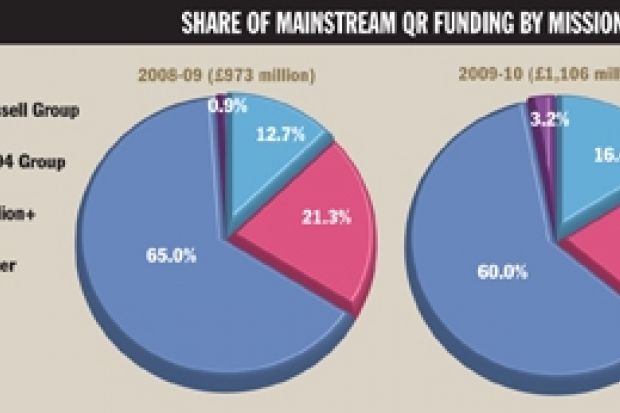
An analysis by Times Higher Education highlights this trend. In terms of mainstream QR cash, 90 per cent of it was shared by 38 universities in 2008-09. This time around, 48 institutions will take a slice.
Some 75 per cent of the money was swallowed up by 22 universities in 2008-09, but in 2009-10, 26 of them will share the spoils.
In total, 25 institutions that previously received no mainstream QR funding will receive it for the first time.
Examples of teaching-led institutions that have won cash at the expense of research-intensive universities include: Edge Hill University, which saw its total research funding rise from £1,222 to nearly £403,000; the University of Lincoln, the funding for which has spiralled from £266,000 to £1.9 million; and London Metropolitan University, which received £768,000 in 2008-09 but nets more than £3.4 million this time around.
Speaking to Times Higher Education, David Sweeney, director of research at Hefce, estimates the results constitute about a 3 per cent drop in the concentration of research cash, but he plays down its significance.
"It is a mild spreading-out of concentration (and) a nice little story that islands of excellence have been identified and funded, as we always said they would be," he says. "But the result is still broadly comparable with previous exercises ... we are continuing to fund world-leading institutions."
He stresses that institutions that did very well in the allocations managed to do it by increasing both the volume and quality of their research. "(They) have had to run quite hard to keep up," he says. "There are some that have done well on quality but haven't kept pace with volume increases in the sector - therefore, they lose their share of the pot. There are others where the volume kept pace but the quality dropped off slightly."
Ring-fenced STEM
One point of contention for teaching-led universities has been the so-called "STEM ring-fence" that Hefce erected following guidance from the Government. It protected the proportion of mainstream QR funding going to science, engineering, maths and medicine. Here the research elite has the advantage.
The protection has come at the expense of humanities and social science funding, where teaching-led universities do better.
Hefce confirms that the ring-fence was drawn around 29 science-based units of assessment, and says it stopped £50.2 million leaking out of science into other subjects. It adds that ring-fencing has led to about an 11 per cent hypothetical swing away from non-science subjects.
Sweeney says the amounts involved show that the ring-fence is "not half as big a deal as was made out ... The driver was quite simply that we weren't going to divert funding into social science and other subjects where the volume increase had happened."
But a backtrack by Hefce on another flashpoint - the eligibility of departments for research degree programme (RDP) funding to support the supervision of postgraduates - is likely to be welcomed by teaching-led universities.
Hefce originally proposed to subject RDP cash to a "quality threshold", so there would be no funding for students in the 15 per cent of departments with the lowest quality weightings. But Sweeney says that on "mature reflection", the Hefce board changed its mind. All departments in receipt of QR funding will now get a share of RDP money, in line with previous principles and pending "a policy review on how best to stimulate collaboration between departments later in the year".
"(Hefce decided) it wouldn't be fair not to fund doctoral students in excellent departments," he says.


Register to continue
Why register?
- Registration is free and only takes a moment
- Once registered, you can read 3 articles a month
- Sign up for our newsletter
Subscribe
Or subscribe for unlimited access to:
- Unlimited access to news, views, insights & reviews
- Digital editions
- Digital access to THE’s university and college rankings analysis
Already registered or a current subscriber? Login