My THELoginRegister
Third Level Navigation:
09 February 2010

Advertisement

Advertisement

Advertisement

-
Main Page Content:

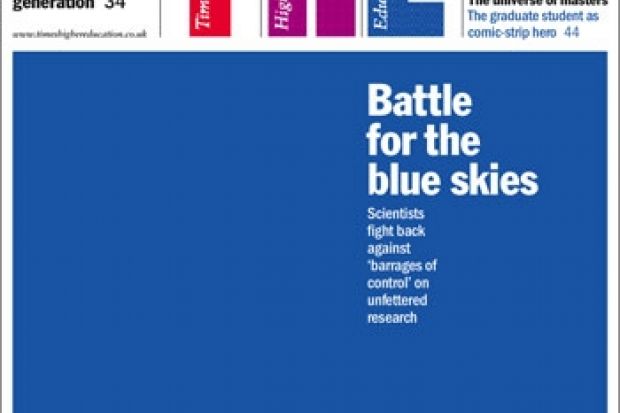
Scientists call for a revolt against grant rule they claim will end blue-skies research

12 February 2009

Letter blames research councils' policies for fall in number of UK Nobel laureates, reports Zoë Corbyn

A "revolt" against the requirement that academics demonstrate the economic impact of their research was called for this week by 20 eminent UK scientists, including Nobel prizewinner Sir Harry Kroto.

In a letter in this issue of Times Higher Education, the group calls for academics to rebel against new rules that state that the potential financial or social effects of research must be highlighted in a two-page "impact summary" in grant applications.

The requirement to provide a summary, answering questions about who might benefit from the research and how a financial return could be ensured, is being phased in by the UK's seven research councils. The summary will be used by peer reviewers as a factor when determining which applications receive funding.

But in the letter, the group, which includes eight fellows of the Royal Society, "urges" the peer reviewers to ignore the summaries - arguing that it is impossible to predict the economic impact of "blue-skies" research in advance.

The letter says peer reviewers "should confine their assessments to matters in which they are demonstrably competent. In research worthy of the name, we are not aware of anyone who would be competent at foretelling specific future benefits and therefore in complying with the request in any meaningful and substantive manner."

The letter also criticises the research councils for policies over the past 30 years that it claims have subjected academics to "withering barrages of control" and turned researchers' lives into "bureaucratic nightmares". The letter blames these policies for "almost a tenfold decrease" in the rate at which UK researchers have been winning Nobel prizes.

"(The research councils) must become more courageous in dealing with the Government or they will not have an enterprise worth protecting," it warns.

It also rounds on the Government for driving academics to increase the economic impact of their work while ignoring the "serious problem" of low-level investment in research and development by British companies.

"What is the point of having a second-to-none academic sector if its commitment to innovation is not matched by commerce and industry? Academics are, of course, a much easier target," the scientists write.

The letter was organised by Donald Braben, a visiting professor at University College London, and Philip Moriarty, a professor of physics at the University of Nottingham. Professor Braben told Times Higher Education that the academics had reached "the last straw" with the councils. One signatory said he would happily sign "in blood", he added.

"The academic community must stand up," said Professor Braben, adding that history showed that even the most seemingly inapplicable of scientific discoveries could yield huge economic benefits, such as the development of lasers.

"You cannot command developments at the frontier, it is not possible," Professor Braben said.

He added that the new policy spelt the end for blue-skies research. "As soon as you identify a beneficiary for research ... the councils are going to turn it around and say, right, deliver. And then it is applied research ... You can't have blue-skies research if you put caveats on it."

Philip Esler, chief executive of the Arts and Humanities Research Council, speaking on behalf of Research Councils UK, said: "The description of impact that the research councils work with is broad, encompassing not only the contribution research makes to the economy but also to society as a whole.

"It covers not only economic benefits, but also those related to public policy, quality of life, health and creative output. Research councils will not be disadvantaging blue-skies research, nor stifling creativity.

"The impact statement is not designed to ask peer reviewers or applicants to predict future benefits. It is intended to allow the applicant to highlight potential pathways to impact, especially through collaboration with partners, and to help the research councils support them in these activities.

"Research councils recognise that impact cannot be solely recognised by the researchers, but requires collaboration with user communities. Where applicants feel that their research is not likely to have an immediate or obvious impact, then they should state that in the application. Excellent research without obvious or immediate impact will not be disadvantaged. We remain committed to supporting excellent research and ensuring that it benefits as many individuals, organisations and nations as possible."

Professor Moriarty said: "No one has attempted this type of grassroots boycott before."

Lord Drayson, the Science Minister, said the UK is committed to increasing the amount invested in research and development by firms, as evidenced by its R&D tax-credit scheme for business.

The 20th signatory of the letter, Herbert Huppert FRS, was added after the letters page of Times Higher Education went to press.

zoe.corbyn@tsleducation.com

21ST-CENTURY WINNERS SO FAR

2001 (Physiology or Medicine)

Paul Nurse

Tim Hunt

2002 (Physiology or Medicine)

Sydney Brenner

John Sulston

2003 (Physiology or Medicine)

Peter Mansfield

2007 (Physiology or Medicine)

Martin Evans

Readers' comments

  • Mark Bretscher, FRS 12 February, 2009

    The suggestion by Don Braben and supporters that grant applicants simply ignore the new requirement of providing a 2 page "impact plan" has an alternative. An all-encompassing "impact plan" could be drawn up and used by all who regard their research as basic but don't have anything helpful to add to their scientific proposal. This would allow the all-powerful bureaucrats to fill their files with that which they think they need. Of course, it might conflict with the Government's green posture........

  • Professor Mike Glazer 12 February, 2009

    Here we go again. This is substantially the same argument we went through during the Thatcher period. Then the catchphrase was "wealth creation". The latest policy is as much misguided as the it was then. It resulted in the Save British Science movement and in the rejection of Mrs Thatcher for an honorary degree in Oxford,as well creating turmoil amongst research scientists. It is high time that scientific research was recognised for what it is: it may be inefficient in terms of directly leading to applied results, but history has demonstrated time and time again that the the really important discoveries, the ones that have transformed our world, have not come about through guided programmes, but instead have turned up accidentally. As always with these government inspired schemes there is a basic confusion between scientific research and technology. It is vital that able scientists are allowed to follow their instincts in research rather than to be dictated to from above. Otherwise, the likely outcome will be the stifling of major discoveries.

  • Professor Lee Cronin 12 February, 2009

    The political establishment presently has an obsession with control, and hides behind the fact the tax payer ultimately funds a large percentage of the scientific endeavours in UK Universities, to exert this in areas which they have no business or understanding. Right now, chemists, like many disciplines may be able to contribute to solving some of the greatest problems of our generation associated with energy, health and pollution. But we must not lose sight of the scientific research process that requires chance, inspiration, free thinking, and the need to embrace the chase of finding out what is possible without justification. Also, I believe fundamentally that scientists, even those funded by the tax payer, should be able to research areas that have no immediate economic value. Ironically, these are the areas which yield incredible insights that can have economic value, or win a noble prize (or both!). Therefore the need to write an impact summary requires a crystal ball that we do not have, unless you are Lord Drayson who apparently has claimed he has a 6th sense; in that case we do not need an impact statement, we just need Lord Drayson sit on the funding committees and tell us which grants are going to generate vast sums of cash.

  • Ken 13 February, 2009

    Let's talk within the context of the sciences - physics, chemistry, biology and medicine. The core of the problem lies in the education and immigration systems in the UK. The education system does not encourage diversity, i.e., too provincial, focusing only on the immediate interests of the nation. The Nobel Prize, afterall, betokens a significant contribution that has a profound impact on human lifes everywhere. Also, much money is wasted on insignificant research and endeavors which have no immediate use to society (RAE is an example). The UK needs to have a more open policy in terms of recruiting brilliant and talented international students, as well as having a more immigrant-friendly environment to retain talented people, many of whom will eventually become citizens. To set up a system that will make winning Nobel prizes a high possibility requires a change of mentality, money and time. The UK needs to focus on the long-term benefits of building such a system. And by the way, talk is cheap.

  • Professor James Ladyman 14 February, 2009

    Given that the majority of the world's experts failed to predict the economic impact of the house price bubble, what chance do researchers outside of economics have of predicting the impact of their research. The RCUK protest that they are not just interested in economic impact but in wider social and cultural benefits. Either way are we supposed to look at benefits over a 5 year, 10 year or 20 year period? The idea of funding academic research on the basis of impact as opposed to its academic merits is absurd because the best predictor of the good consequences that will flow from research is academic excellence.

  • Ken 14 February, 2009

    Professor James Ladyman, research in areas such as energy and medicine would have both economic impact and academic merit. As for what defines long-term, that would depend very much on the consensus of the scientists and researchers in your country.

  • Dave 14 February, 2009

    "research in areas such as energy and medicine would have both economic impact and academic merit." - okay, so we can take that as read, then. So no need to quantify such impacts in a grant application. That confirms that this new directive is a pointless and time consuming exercise.

  • F Kovacs 16 February, 2009

    Making scientific research a subject to money/making is no wonder at all. That has been expected for some time, when universites have been reorganized to emulate business ventures. Today there is no way to come up with a new idea and put in practice, unless somebody else can make a lot of money on that. Science is not focused on solving problems but on finding new ways of making money. Everybody accepts the primacy of money, so why be surprised? Not that I like it, but cannot change it either.

  • Editor's comment

    Steven Hill, head of Research Councils UK's Strategy Unit, has responded to the scientists’ letter and the Times Higher Education articles via his blog. See http://hypotheses.wordpress.com/2009/02/13/a-nobel-effort/

    Ann Mroz
    Editor, THE

  • John D. 18 February, 2009

    What would Watson and Crick have written in their grant application? Wouild they have said: we plan to discover the structure of DNA, which several decades from now will become the basis for the science of genomics and the industry of biotechnology, as well as the source of many important discoveries and applications in medicine.

  • Martin Sahlén 24 February, 2009

    It is worrying to see the stance of the UK government on this important issue, however they might protest that no-one will be disadvantaged. All of academic research cannot, to fulfil its full functional potential, be made to oblige under typically short-sighted or simply ill-defined socio-economic cost-benefit analyses. A crucial part of academic research is that of re-imagining the frameworks within which society operates. If reduced to a set of cogs in the already-existing machine, the crucial function of creating new machines (or whichever analogy may appeal to the reader) will be significantly hampered. At a time in history when creative transformation is crucial to our survival, traditional universities and their researchers should be allowed and encouraged to foster new, sustainable solutions as freely as possible. I fear that the direction suggested by the UK government will rather align funded research to a vision of technocratic tinkering with a fundamentally unsustainable system, and we shall all be the poorer for it - whatever economic impact analyses may proclaim. Let's not waste our creative potential that way.

  • Matthew Karlsen 24 February, 2009

    In addition to the overall argument that it is "impossible to predict the economic impact of "blue-skies" research in advance" the question of how you measure "economic impact" and what it really means for society as a whole are also very important. Even if you could accurately predict the economic impact of a particular project (both the direct impact *and* the benefits of all the future research that the initial research leads to) economic impact is a very poor measure of overall benefit to society. For instance, GDP provides a very bad measure of the overall success of a society (thus the proliferation of alternative measures of well-being such as GNH and HPI). Goods and services developed as a defensive measure against the negative impacts of economic/industrial activity can be said to have an "economic impact" but overall people are out of pocket with little improvement to their lives (this relates to the "parable of the broken window"). Research of real benefit to society does not necessarily show up on the bottom line.

  • Paul Healey 27 February, 2009

    Imposing or not imposing a new economic impact criteria trivialises the problem. What I would like to see addressed, is the basis for decisions on research funding. That is, what is the legal basis for either recognising, or not recognising different schools of thought doing research on the same topic? I think such schools should be recognised; fairly represented, else, democracy becomes a bad joke. For without the choice to think differently, the idea of a majority becomes a direct attack on the notion of freedom itself; it becomes a contradiction: the government’s freedom is based on the denial of the researcher’s freedom. Freedom should mean the freedom to think differently. Freedom, should not mean conformity to a set of unmediated and or abstract standards of excellence, else, it is not freedom. By reducing the problem to the case of imposing or not imposing, the issue can be made to look like one of control versus anarchy, where as, it should be be about how decisions are mediated for the benefit of others rights and interests.

Comment on this story

Post your comment

You must fill in all fields marked *

12 February, 2009


Main site navigation:
Secondary site navigation:
Main site navigation end
-
 
-
Abacus E-media
Abacus e-Media
St. Andrews Court
St. Michaels Road
Portsmouth
PO1 2JH
-

Advertisement